If you’re lucky enough to live in the Lowcountry, every day is a vacation waiting to happen. Follow us over the river and through the marsh…
Focus on Film: Part III
Tuesday, 16 March 2010 10:16
Chilled Big: How our hot film scene got iced and what can be done to thaw it out
"It wouldn’t be a movie made from my book, I can tell you that. It just wouldn’t be. Nothing any of these legislators can do will have as lasting an impact on tourism, on business – on anything else – than getting a movie made in South Carolina."
– Author Pat Conroy on the possibility his books might not be filmed SC
The weekend prior to the opening of the fourth annual Beaufort International Film Festival, something akin to David’s slaying of Goliath happened in theaters around the country. A tiny, unheralded, poorly reviewed film adaptation of Nicholas Sparks’ novel, Dear John, knocked James Cameron’s behemoth sci-fi spectacle, Avatar, from atop the box office charts. Granted, Avatar’s race was almost run. The all-time top domestic and worldwide grosser was due to be toppled after dominating all comers for months and sucking up more than $700 million in domestic ticket sales. But Dear John’s opening triumph had a special resonance for anyone associated with the film industry in South Carolina. Shot back in 2008, Dear John is the last “big” movie to film in the state, making its title all the more ironic. And “big” is a relative term. The average budget for a major studio production is easily north of one hundred million dollars. Avatar is reported to have cost more than three times that amount. Dear John comes in at a relatively meager 25 million dollars, most of which was injected directly into South Carolina’s habitually anemic economy. Meanwhile our neighboring states continue to do big and bigger business with Hollywood. Dear John is both a reminder of how things used to be and a faint glimmer of hope for a return to those days – a very faint glimmer.
“This is an industry [in South Carolina] that is facing some tough headwinds,” says State Film Commissioner Jeff Monks. “When our incentives were reduced and our competitors’ incentives increased, South Carolina fell off the charts in Hollywood.”
There it is, the “I” word: incentives. Quite possibly the most important and pervasive term associated with modern American filmmaking apart from “CGI” and “directed by Steven Spielberg.” The concept is simple: offer television and film productions incentives in the form of tax rebates – a certain amount of cash back per dollar spent, often with a liberal cap on the total refund. I won’t bore you with the math. There’s plenty of it and it’s probably best explained by a tax attorney or anyone who’s ever cashed a production company paycheck. Often there are stipulations and codicils aimed to encourage hiring from within the indigenous talent pool – provided there actually is one. This too becomes a problem since the talent pool tends to go where the movies are actually being produced (which is not here). The bigger the incentive package, the bigger the project it attracts. It’s literally like fishing: the bigger the bait, the bigger the fish. Our neighbors are hooking marlin in deep water while we’re back at the pond with a cane poll and a can of worms.
In short, with our current incentives structure South Carolina is simply not in the hunt for the big fish. And at risk of running the analogy aground, this is pretty tough to swallow with so many trophies on the wall.
What the hell happened?
“In 2006 the SC Department of commerce decided that our incentives were too aggressive,” explains Monks. “This is after they had just been passed and instituted and we recruited seven feature films, two television pilots and our first ever TV series.” Here’s where it gets weird. Essentially, the State Commerce Department, under brand new Sanford appointee and former Southland Log Home CEO, Joe E. Taylor, Jr. determined that the incentives were too lucrative. Department bloodhounds sniffed out a loophole in the legislation – legislation passed with the bi-partisan support of both houses – and dramatically slashed the entire program. A fairly competitive, across-the -board wage rebate of 20% was cut to 10% for non-state residents and capped at $3500 per person. At the same time more than a dozen other states either created brand new packages or boosted existing incentives as the competition for bigger more expensive projects heated up. In essence, the state changed the rules in the middle of the game. Literally overnight we yanked out the “Welcome” sign and planted “Keep Out!” in its place. This is almost literally like having the lottery folks roll up to your front door with a tractor trailer full of cash while you step out on the porch with a shotgun and yell, “Get off my lawn!” And they did. In the aftermath, the Commerce Department slogan “South Carolina means business” might as well include a parenthetical (Any business but the film business).
A nasty shock wave rippled through Hollywood. After decades of building South Carolina’s reputation as a prime feature film location brick by brick, the fiscal temblor that rumbled west out of Columbia reduced the walls of good intentions to a dust bowl of ill will. Anyone who deals with “The Industry” knows Hollywood’s like an elephant, it’s got a long memory.
The Competition
Robert Redford’s upcoming historical drama, The Conspirator, recently wrapped production after several months of shooting in and around Savannah. The Civil War era picture deals with the aftermath of the Lincoln assassination and the trial of Mary Surratt, the only woman charged in the conspiracy. Both Charleston and Beaufort were considered by the producers, if only briefly.
“Incentives were the deal breaker,” says Carlotta Ungaro, President of the Beaufort Regional Chamber of Commerce. “Deal breaker for us, deal maker for Georgia.”
According to the Georgia Film Commission during fiscal year of 2008-2009 television and film projects dropped $641 million in the state with a total economic impact of $1.15 billion. And our neighbors to the south appreciate the importance of promoting their product. All a film or TV production has to do to raise the state’s flat 20% rebate to 30% is slap an official Georgia peach logo at the end of the credits. But Louisiana leads the pack with a base incentive package of 30%, with flexibility to boost that another 5%. The state film office website currently lists a jaw-dropping 63 feature films shooting over the past 15 months. Let’s not forget the 13 television series, as well, and all of this in a state with significantly less location diversity and infrastructure than South Carolina.
“Of all the industries out there, the film industry is the most sensitive to incentives,” says Ungaro. The Chamber also oversees the Beaufort Film Commission and is pushing for a more competitive incentive package. In other words, throw Hollywood a bone and as Ungaro points out, “Everybody’s throwing bones. If we want in we’ve got to play the incentives game.”
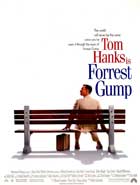
Movie money is easy money and a lot of it used to pump through this state in the form of blockbusters like The Prince of Tides, Die Hard With a Vengeance and Forrest Gump.
A big budget film means a massive and immediate cash flow into the local economy. Hotels are booked, restaurants and bars are filled, local suppliers watch sales spike. Jim Passanante was born into the business in Hollywood, but moved to the Lowcountry with the movie boom in the early ‘90’s. The scenic artist and set-builder has more than 70 feature films to his credit, including Gump, Big Fish and The Conspirator. For Passanante and his peers getting South Carolina back in the film business is a no-brainer. “I was the painter on Die Hard III,” he says. “I spent $350,000 dollars on paint. I had 52 people working for me. I had a payroll of about $165,000 a week. Plus all these people had per diems. So think of how much money was put back in the community.” The local paint store threw his crew a thank you barbecue when production wrapped. “They’d never had anybody spend that kind of money,” he recalls. “Get the tax incentives back and you’ll have more movies than you know what to do with.”
Besides the immediate local economic impact, there is the long term. The film and television business attracts all sorts of support businesses. Many of them are high tech and green. And then there’s the Forrest Gump Factor. Soon after that big budget movie spends millions of dollars and employees hundreds of people, it opens on thousands of screens across the country and the globe. “You’re marketed to the world,” says Ungaro.
It simply makes sense for a state dependent on tourism to pursue that kind of spotlight. That’s not going to happen until the attitudes and policies shift in Columbia, something Ungaro and others are urging local legislators to champion. “We are dependent on the policies of our state,” she explains, “because Beaufort’s not going to get a look if the [movies] are not looking at the state.”
Email Mark Shaffer at
This e-mail address is being protected from spambots. You need JavaScript enabled to view it
Son of Santini
Monday, 01 March 2010 12:08
A conversation with actor Michael O’Keefe in the house where it all took place
Actor Michael O’Keefe first came to Beaufort in late 1978 to play the part of Author Pat Conroy’s alter ego, Ben Meechum, in the film adaptation of The Great Santini. The role would garner Oscar nominations for O’Keefe and co-star Robert Duvall. It would also mark the beginning of a lasting friendship between O’Keefe, Conroy and actress Blythe Danner who embodied the film version of the author’s mother. The trio reunited for the 2010 edition of BIFF and were feted with a cocktail reception at Tidalholm, the historic old house where both Santini and The Big Chill were filmed. Mr. O’Keefe was gracious enough to take a break from the well-heeled cacophony to sit down for a few minutes in the den at Tidalholm. The conversation took place beneath a framed poster from The Great Santini.
Mark Shaffer: How does this feel? Is it a weird sense of déjà vu or is it a little like coming home?
Michael O’Keefe: It’s like going into a house I grew up in. I was here last year when they screened the film and I wanted to go into my room, I wanted to see the room I grew up in, as it were. And it felt like a house that I had childhood experiences in.
MS: Well, you did in a way. You were 23 when you shot the film, but it had to feel like a big family experience with everyone hanging out on The Point.
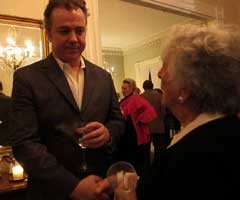
MO: We were all here. We never really went anywhere else but Beaufort. We were sure in this house a lot – all told about three months. It was an extraordinary experience for sure.
MS: Did you find yourself acclimating to a Lowcountry lifestyle like your character Ben Meechum did?
MO: When you’re making a movie you work all day and (especially when I was younger) you look to blow off a little steam when you’re through. Then you’ve got to get up at five in the morning, so you get into this sort of encapsulated world were everything’s insular. I had some contact with the locals because Pat Conroy was here and occasionally we would see something or do something or be somewhere, so we had some connection to the community. But mainly we were this little roving city making the movie and then we all disappeared when it was over. I didn’t come back for thirty years.
MS: Both the novel and the film are iconic things for this town. When you come to Beaufort, you’re not just remembered for having played a role in a famous film that was shot here, you’re a Conroy character – you’re part of that canon.
MO: It’s true. One of the reasons I came down last year was that Pat had South of Broad coming out. He was doing a signing at Bay Street Trading Company and Lisa Estes, the owner, had me sign copies of the book, too. So there’s this connection between us from me playing his alter ego in the movie. The line was unbelievable . He signed books for about five hours. Incredible.
MS: I remember. There were literally hundreds of people walking the streets of Beaufort with big stacks of Pat Conroy books under their arms. It was a little eerie.
MO: I remember the first time I met him was in Charleston and he came walking up looking like he’d seen a ghost. I’m a little taller than he is, but we do sort of have similar features. He saw me and goes (in astonished whisper) ‘Where’d they find you?’
MS: You soon found out that the two of you had a lot in common.
MO: We’re both the oldest of seven kids, we’re both Irish Catholics, both raised by arguably dangerous, charismatic, powerful fathers. I mean one of the reasons I got the part was that I know that world. I’m very familiar with that kind of dynamic. So for me to get the opportunity to turn that into something I could use was a big part of becoming an actor, and that role was a big part of me kind of going as far as you can go with that sort of thing.
MS: It still holds up. I just recently watched it again.
MO: I had not seen it since it was released. So when I finally did see it again last year, the thing for me to watch is Bobby [Duvall] and Blythe [Danner]. When you watch Duvall’s rage and brutality and humor and – forgive the word – bullish instincts and balance that with Blythe’s compassion and patience and wisdom and long-suffering endurance for the family, for my money that’s the real meat of the movie. And the two of them are both experts in that kind of spontaneous moment-to-moment reality. When I was that young my work was suffering, I wasn’t that spontaneous. I was thinking about how I should do it. They were just extraordinary to watch.
MS: Bull Meechum was a breakout role for Duvall and Pat says his dad was fond of claiming credit for Duvall’s career, that maybe Duvall owed him a little piece of the action.
MO: (Laughs) That’s not bad, that’s not far off. The day we shot the basketball scene [Pat’s father] Don was here with Pat. The two of them watched us do that scene.
MS: That had to be a bit surreal.
MO: It was intense. Yeah, it was interesting. I mean Don was an interesting character, you know?
MS: I get the feeling that not only would the real life father and son watching on the sidelines raise the intensity level with that part of their lives being portrayed, but that Robert Duvall comes fully charged himself.
MO: He doesn’t pull his punches, if you know what I mean. He didn’t do that. (Laughing) I was constantly like ‘Okay man, it’s just a movie! Just a movie!’ Of course, it all pays off on film. He was at the height of his powers. He still had that youth and athleticism.
MS: He’d just finished Francis Ford Coppola’s Apocalypse Now when he showed up here.
MO: [Santini] was the movie he made right after Apocalypse. Oddly enough I had screen tested for the role in L.A. and I was at Sean Penn’s house because his father, Leo, had directed me when I was a teenager. He had me over for lunch or something and I knew I had the part. Martin Sheen lived next door and as we’re leaving Leo caught Marty and said, ‘This is Michael O’Keefe. He’s going to work with Bobby Duvall in South Carolina.’
MS: Tiny circles. And there the two of you were on Oscar night. What was that like at 23?
MO: I was probably too young to appreciate it. Twenty years later you kind of go ‘oh, I guess that was a pretty cool thing.’ If I’d won I certainly would have been fumbling for something to say because I hadn’t prepared anything. Last year when I was watching the film, I relate to that being me, but it’s another lifetime. Now, it seems almost like a dream.
The Prince of Titles: Part I
Monday, 01 March 2010 12:05
A conversation with bestselling author Pat Conroy about his work from the page to the screen
Story and Photos by Mark Shaffer
The first major motion picture shot in South Carolina was the adaptation of Pat Conroy’s first novel. The Great Santini was also the first film to shoot in Beaufort and the movie that put the state – and the Lowcountry – on Hollywood’s hot sheet. Four of his books have made it to the big screen, so far (all but one were filmed here). The only Conroy property that hasn’t been optioned is his cookbook, and with the success of Julie and Julia, I wouldn’t rule that out. Beach Music and his current bestseller, South of Broad, are said to be heating up. Brad Pitt’s Plan B Entertainment owns the rights to My Losing Season, a property begging to be fast-tracked considering the recent blockbuster success of The Blind Side – another sports story with a message.
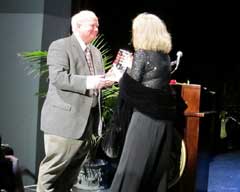
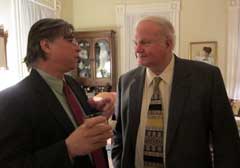
During the culmination of the 2010 Beaufort International Film Festival (February 18-20) Conroy was presented the Jean Ribaut Award for Writing Excellence, a hometown honor he says he was “sincerely thrilled” to receive. The night before, Pat along with friends and Santini cast mates, Blythe Danner and Michael O’Keefe, attended a cocktail reception at Tidalholm, where much of the film was shot (see the accompanying interview with O’Keefe). Our plan to have this conversation “on location” proved foolhardy. Famous authors and actors are much in demand at such affairs it seems. A few days later Pat called and during the brief pre-interview chit-chat I mentioned that his friend O’Keefe had a website. “Does Blythe have one?” he asked. “I’m not sure,” I said, “but I wouldn’t be surprised. These days everybody seems to have one.” “I know,” he replied. “I just found out I have one. It came as a complete shock.”
The Interview, Part I
Mark Shaffer: Santini was a life-changing event for a lot of people. What was it like to watch Michael O’Keefe breathe life into Ben Meechum?
Pat Conroy: He was a kid. It was amazing to watch. I hadn’t seen the movie in twenty, twenty-five years, and it shocked me how good it was.
MS: It holds up pretty well.
PC: I was completely stunned. These people were great actors.
MS: Does it still seem a little weird that Michael is, in effect, playing you?
PC: How about this: I’m sitting in Bay Street Trading Company signing books [last year] and he’s in the Verdier House signing The Great Santini across the street. It’s like this guy took possession of my soul and never quite let go, which is strange to me. It always is.
MS: He mentioned that. He says that there’s been a connection between the two of you from that first meeting in Charleston before filming began.
PC: No question. Also people tell me he looked kind of like me when I was in high school. And Blythe Danner certainly had a resemblance to my mother.
MS: Speaking of that, I really enjoyed your awards speech, particularly the part about your family’s reaction to their film selves.
PC: Oh, my God. I’m so full of B.S. I never know what I say anymore. I’ve got about four hours of crap I can get up and talk about. You never know what’s going to come out at any particular moment. Did I tell the story of the movie coming out in Beaufort?
MS: No.
PC: My family is sitting in the front row and the town of Beaufort is sitting behind them. (Laughs) Good God. And when Duvall beat up the whole family in the movie, the town of Beaufort is actually a bit disturbed that the real family is sitting there and they’re being torn apart by Robert Duvall on screen. There’s this shocked noise going through the audience, this whisper. And when it was over, when Duvall had beat up his family and stumbled out drunkenly into the night, my brother, Jim, leans down at the end of the aisle and says “Bambi. Duvall was Bambi compared to Dad. They should’ve let Dad show Duvall how to really tear up a family.” And of course, the Conroys – being us – screamed with laughter. Naturally the town thought we were more nuts than they must have thought we were before. That’s the favorite story about the family first seeing the movie.
MS: You once told me that they were all horrified at the idea of the film being made, but they all loved the film versions of themselves.
PC: Oh my God, they went crazy.
MS: Santini was the second book to make it to film. You’ve said it always freaks you out a little when Jon Voight introduces himself on screen as you in Conrack (the film version of The Water is Wide). I hadn’t heard that he wouldn’t talk to you on set.
PC: I did not realize until I read Christopher Dickey’s book Summer of Deliverance: A Memoir of Father and Son that James Dickey had practically driven Voight and Burt Reynolds nuts on the set of Deliverance. So I didn’t know what the reason was for about twenty years. He just didn’t seem interested in talking to me at all.
MS: He just associated you with your old professor – your mentor – and his tormentor.
PC: Yes. The one thing that I get to brag to my children about is that I got to meet Angelina Jolie who was six months old. And I tell my kids I whispered, ‘go into showbiz kid, you’ve got it.’
MS: I literally bumped into her at a screening in Vegas once and she scared the crap out of me. But that was her Billy Bob phase. Very scary.
PC: (Laughs) I’m sure. I’m absolutely sure.
MS: The set of Santini must have been quite a departure from the Conrack experience.
PC: It was wonderful. I got to watch my mother teaching Blythe Danner how to say the Rosary (laughs). Dad and Mom had not spoken since the divorce and there was tremendous tension when I brought dad on because Mom had the movie crew thinking it would be like meeting Godzilla. And so when I first brought Dad on [set] people were reeling back in horror. Mom had done a great job. She won the PR battle on that particular front, hands down.
MS: But your dad was a pretty charming guy,
PC: And he became even more charming. And once again, after the movie and the book my father changed his entire personality. (Laughs) I didn’t even recognize him the last fifteen years of his life. I’d say “Dad, where was this great, great guy when I was growing up – this fabulous, wonderful, animated, witty guy that I missed for the first twenty-one years of my life?’
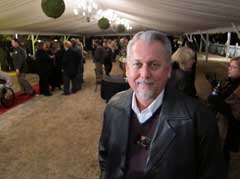
MS: What was his answer?
PC: His answer was to say, “Son, you were too shallow to know the real father who was raising you.” Dad was very good, very good at that.
MS: Were you still living on The Point when they were shooting the movie?
PC: I was in Atlanta by that time. But it was amazing to watch this thing being filmed on The Point – to watch that amazing scene [between Duvall and O’Keefe] being filmed on the Green. So it all seems related. Having that party in Tidalholm was very moving to me.
MS: How did that feel? I got the sense from Michael that it was a little eerie, but in a good way.
PC: Well, it was very strange for me. You know I used to show people where the basketball court was. I’d drive up in the driveway and stop at the gate and show people where the basketball scene was filmed. This took place on my tour of Beaufort. And I remember I was sad when they took the basketball goal down, as if a part of my youth was somehow stolen in that very moment.
MS: I almost feel as though it should have been designated as some sort of historic landmark.
PC: And The Big Chill was made there, Forest Gump [was shot in Beaufort], and it’s funny how these movies have become part of my tour: showing people where Barbra Streisand stayed or where Nick Nolte stayed. Blythe Danner stayed in one of my favorite houses in Beaufort, near where I used to live on Hancock. It used to be called The Treehouse – very modest, but very beautiful. She told me the other night that that was one of the happiest times for her children in their lives, the making of The Great Santini.
MS: [Danner’s daughter] Gwyneth Paltrow’s mentioned in interviews that her time in Beaufort was among the happiest of her childhood, running wild and barefoot through The Point.
PC: No kidding? That’s wonderful. You know, it was wonderful meeting her. She was a little girl then. Of course, I tell all my children that I told her ‘Make sure you get in the movies. You’ve got it, kid.’
(Laughter)
MS: Once again that proved prophetic.
PC: My kids are not jealous of me for having met Robert Duvall or Blythe Danner or Jon Voight, but they are hideously jealous that I met a six month-old Angelina Jolie and a six-year old Gwyneth Paltrow.
MS: When I talked to Michael [O’Keefe] in the house where the movie was filmed, he mentioned that both you and your Dad were on the sidelines to watch them shoot the infamous basketball scene.
PC: Yes, we were watching that. What a happy day that was…
To be Continued…
Coming up in the March 17th issue, part two of our conversation with Pat Conroy, including:
How The Great Santini helped heal deep family wounds
Why Robert Duvall owes his career to The Colonel
The possibility of more books on film
And why the state needs to get back in Hollywood’s good graces
Get more online at www.lcweekly.com and email Mark Shaffer at
This e-mail address is being protected from spambots. You need JavaScript enabled to view it
Focus on Film, Part II: Cinéma Fantastique!
Monday, 01 March 2010 11:44
Observations et Impressions du Festival de Film International de Beaufort
Story and Photos by Mark Shaffer
Okay, so the Beaufort International Film Festival is not a glitzy star-studded celebrity fleshpot on the French Riviera. No scantily clad starlets preening for a phalanx of paparazzi. No superstar couples herding newly adopted multi-national brat packs in and out of Baby Gucci between latte stops. Nope. We’ve got none of that. But in the parlance of the entertainment industry trades: BIFF = BOFFO! And you can take that to the bank.
“How the hell did you manage to pull something like this off in Beaufort, South Carolina?”
- 2010 BIFF Honoree Pat Conroy to Festival Director, Ron Tucker
The Wrap
Ron Tucker is over the moon, euphoric – and not just because he’s finally had a good night’s sleep. Three days after the close of the fourth annual event the accolades and the numbers continue to roll in. BIFF’s first run under the tent pole of the fledgling Beaufort Film Society (Tucker’s the founder and CEO) is a bona fide smash. Total attendance exceeds all expectations, doubling the previous year’s watermark. The final tally approaches four thousand. To borrow a favorite movie line, if that trend continues they’re going to need a bigger boat. Meanwhile the calls and emails continue, particularly from the filmmakers, many of whom where plotting their return before they left town.
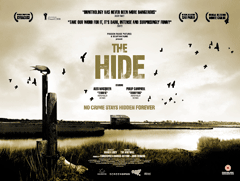
“John Schwab and Gary Weeks told me as we were leaving the awards gala that they were ready to collaborate on a project together,” says Tucker. “I told them to bring it here and they said they were going to do their best to make that happen.” The two young filmmakers, representing London and Los Angeles, respectively, also competed for the festival’s top prize. Schwab’s The Hide edged out Weeks’ Deadland for Best Feature. But at the screenings all sense of competition was absent, replaced by something more like camaraderie, says Tucker. “The filmmakers all showed up to support each other. They all connected.” And within hours of the opening gala the wheels begin to turn on potential deals. Cards, scripts and DVD’s change hands; partnerships and collaborations are discussed. The buzz is palpable. There’s a live current crackling in the air, in the theater, and all over town.
This is the special alchemy of any gathering of highly talented, creative people from vastly different places, all passionate about their work. It is also precisely what festival organizers hoped for and what the state’s beleaguered film industry needs. “Our independent filmmaking front has been really active over the last three years,” says State Film Commissioner Jeff Monks. “I think in our last newsletter we noted three or four independent films shooting around the state. So that’s encouraging.”
These days the state film office needs all the encouragement it can get. As competition for big budget productions has heated up all around us, the prevailing political winds in Columbia have blown an arctic gale in Hollywood’s direction. “It’s a small town,” says Monks. “People notice these things.” The film industry has responded in kind. Let’s put it this way, if recruiting major motion picture projects is anything like hockey, South Carolina’s been in the penalty box for a very long time. (More on that in the March 17th issue)
The Buzz
Saturday afternoon before the awards gala and the bar at Emily’s Restaurant is buzzing with BIFF attendees, filmmakers and their families. I’m sitting at the bar with Gary Weeks, a triple threat as actor/writer/producer (check him out on imdb.com). After more than a decade of steady success on the Hollywood scene, Weeks is still a small town kid from Georgia who brought his mom to BIFF.
“I’ve been to a lot of the big festivals and it’s not the same,” he says. “It’s all business. You’re just there to sell your film – and that’s what you have to do. But at something like this you get to meet the actual filmmakers and hang out with them, see their films. Connect. I’ve seen eighteen films this weekend and met most of those people.” One of those people is Josh Dove, the very unlikely hero of the short student film MacAwsome and its spin-off web series (macawesome.tv). The puckish youngster was floored after Weeks pulled him aside following the film to hand him a card and talk about casting Josh in his next project.
“That was pretty cool,” says Josh. This is his first film festival. It won’t be his last.
“The kid’s definitely got something,” declares Weeks, in full-on producer mode. “You never know. He could be the next Tom Hanks.”
If BIFF presented a special award for “distance traveled” Scott Wurth’s a lock. He’s come from the Blue Mountains of Australia which means that he’ll finally be adjusting to the fourteen-hour time difference somewhere over the Pacific on his way home. His Tira Bakal is an unflinching, often brutal, twenty-five minute documentary about a Filipino passion play that took five years to shoot. “You’ve got to be passionate about it,” He says. “It’s not like I’m in it for the money.” Indeed, like so many of his colleagues he finances his filmmaking habit by selling antiques and shooting still photography. He’s a veteran of the international film festival circuit and sees big things for BIFF. “Just not too big,” he says. “That would ruin it.”
Local author Teresa Bruce, a finalist in the inaugural screenplay category, may see an immediate benefit from her BIFF experience. “I’m working on a piece on spec for one of the [feature] directors,” she says. “So if it pans out BIFF may have sparked an actual writing gig. Ultimately my dream would be to collaborate with a Gary Weeks or a John Schwab who comes to BIFF each year and do it here.”
That would suit Ron Tucker just fine. And who knows? When the lights dim for the 2011 edition of BIFF perhaps we’ll be watching films born out of this year’s festival, shot right here in our own back yard.
Coming up in the March 17th issue:
Focus on Film Part III
Chilled Big:Thawing South Carolina’s Frigid Relationship With Hollywood
Mark Shaffer’s email is
This e-mail address is being protected from spambots. You need JavaScript enabled to view it
The Repeat Contender
Wednesday, 17 February 2010 20:20
John Schwab's glad to be back at BIFF
Last year John Schwab’s entire family gathered in Beaufort to see his short feature, “The Applicant,” take the trophy in its category at BIFF. This year John – who lives in England – once again makes the long hop across the pond, as his full-length feature film "The Hide" is in competition as a finalist. While he now makes his home in Old Blighty, John’s an American military brat who spent part of his youth in Beaufort and can’t wait to get back to the Lowcountry. He is just one of a number of filmmakers traversing oceans and continents to participate in this year’s festival. We spanned the vast expanse of the Atlantic via email.
Mark Shaffer: Why travel such a distance and undertake such expense for this thing - what makes BIFF so special?
John Schwab: It's funny. As a producer, one is always looking to save money or find an excuse not to spend money. I know that sounds weird, but it's kind of the truth. We love to spend money, but we also hate to spend money. I could explain in detail but I would need more words than your magazine would allow. I’m absorbing the expense of international travel because I believe that any festival that has taken the time to watch your film and select it – whether it be a short film or a feature or a documentary – It’s the filmmaker's duty (in my opinion) to support the film on that journey as best as they can. Film festivals rely not only on the support of the filmmakers but the audiences who turn out to watch the films. I live in London, but I think a flight across the Atlantic to Beaufort, South Carolina is a small price to pay to support "The Hide."
M.S. “The Hide” has already had some festival success.
J.S. "The Hide" has had a great run on the festival circuit and we’ve tried to attend as many as possible. Obviously, the reality is that you cannot attend every one. For example, we premiered at the prestigious Dinard Film Festival in France which showcases the best of British cinema of that year. The following week we had our South American premiere at the Sao Paolo International Film Festival. It wasn't possible to attend them both, but we do honestly try. Now enough talk about money! And distance! I really wanted to go to Brazil!!!!
M.S. What was last year’s experience like and was it what you expected?
J.S. It was my first time, and I can absolutely assure you that this year will not be my last. I think that Beaufort has an amazing cinematic history that is well worth supporting. I will continue to attend BIFF whether or not I have a film at the festival. I must say that I did have preconceptions about how the festival would be supported, knowing that it is a festival in its infancy and all that that entails. But Ron Tucker and his team put together a great festival last year. I was impressed with the amount of people attending the screenings of every film. I have been to film festivals around the major cities in England (and beyond) that haven't had as many people attending the screenings as Beaufort had last year.
M.S. Would your participation in something like BIFF influence your decision to shoot a film here someday should that possibility arise?
J.S. I was lucky enough to win the Best Short Film award last year. In my acceptance speech, I mentioned the fact that South Carolina didn't have incentives in place to attract local, nationwide and international projects to South Carolina, and that SC was losing out to its neighbors in the north. I am sure that the people of Beaufort know about their film heritage, but not many people outside of Beaufort do. When I tell people in England that I am going to Beaufort for their film festival, they always say "Beaufort? Where the hell is that?" I always tell them that it's where they have filmed some of the most memorable films of all time including “Prince of Tides,” “The Big Chill,” “Full Metal Jacket” and “Forrest Gump.” Also, one of my favorite and most underrated films “The Great Santini.” I would love to one day add to that list.
I am currently Exec Producing a film that I would love to film in and around Beaufort, and the producers and I have been looking at South Carolina, New Mexico and Texas as possible locations. South Carolina is looking the most attractive. And if anyone out there wants to talk about the project, you know where I will be on the weekend of the 17th of February! Script and budget available on request.
M.S. How did you find out about BIFF?
J.S. Last year I happened to stumble upon the fact that Beaufort had a film festival while submitting my short film "The Applicant" to various festivals via withoutabox (an invaluable tool for any independent filmmaker). The fact that I spent 3 years growing up in Beaufort, I thought it would be a great idea to submit to the BIFF.
M.S. What would you change about it?
J.S. It's hard to say what I would change about the festival. I think it's just about right for its size. Obviously, as the festival gets bigger, things would have to change logistically. I think at least feature films could be screened from their 35mm prints. I totally understand the logistics involved in getting 10-20 prints projected over 2 days, but it adds that much more prestige and glamour to the festival.
M.S. What would you absolutely not change?
J.S. I would absolutely not change the charm of the festival. Keeping it a smaller festival (at least for the next few years) is going to allow BIFF to show the filmmaking community what a small film festival can achieve. Beaufort is a stunning city in architecture, culture and people. The more people who come and sample the hospitality of the BIFF, the more people will return with future projects. Last year was such a great experience, and I immediately thought about submitting “The Hide” into this year's festival. We were in post-production at the time, but Ron Tucker, the festival director, mentioned it and I thought "Why not?" It's worth a shot. I’m glad I did, and there are five good finalists in the feature film section this year.
M.S. Aside from the festival itself, what are you most looking forward to during your time here?
J.S. Aside from the festival, I am most looking forward to seeing my family. Or at least part of my family. My parents are coming in from Pensacola, Florida and my brother is coming in from Chicago. Sadly, my sisters aren't able to come this year. Last year the entire family drove through the night on Thursday (including my sister Kathy who drove from Austin!) just to get to Beaufort in time for the festival. And the FOOD!!!! I live in London but hail from the Deep South. So I seriously miss the food. Cornbread, sweet tea, fried catfish, fresh oysters, crab, a good steak (the English although great cattle raisers, haven't seemed to master a good steak!) pecan pie, shrimp gumbo... I'll stop, or I'll start sounding like Forrest Gump!
M.S. What’s your best memory of last year’s BIFF?
J.S. My best memory of the BIFF was watching my short film "The Applicant" in the cinema with my entire family. The Six of us hadn't been alone together for many, many years. So to spend those two days in each other's pockets was a real Godsend. We looked at our old schools, our old house, walked along the riverfront, visited the shops - just had the most wonderful time.
The one moment to maybe top that – in fact, it probably does... My parents lost their house in Hurricane Ivan. Many things were destroyed, memories collected from around the world in Dad's thirty years of military service. One thing that was lost was a painting of a flower lady (I believe) that Nancy Ricker Rhett painted. It was utterly precious to my mom. We went into her gallery and found a print of that same painting. While Mom and Dad were distracted, the kids pooled their money and bought the print. We gave it to them outside the gallery. Mom and Dad welled up with tears, then we did. Many hugs followed. That's what the Beaufort International Film Festival gave to me last year. And that's why I will be returning again and again.