If you’re lucky enough to live in the Lowcountry, every day is a vacation waiting to happen. Follow us over the river and through the marsh…
Cooking 'Simple Fresh Southern' with The Lee Brothers
Tuesday, 13 April 2010 13:28
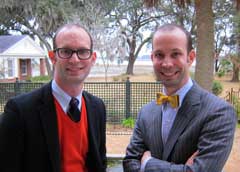
The Backyard Tourist sits down with Charleston’s sibling foodie phenoms
Boiled Peanuts and Pickled Grapes
A few years ago Matt and Ted Lee gently shook up the culinary landscape with The Lee Bros. Southern Cookbook. Sprawled among its hefty five hundred and ninety pages were the usual suspects of the Southern table like Fried Chicken and Red Velvet Cake. But there were also exotic upstarts like Scuppernong Grape and Hot-Pepper-Roasted Duck. The book won just about every award out there and was honored as the 2007 James Beard Cookbook of the Year, the foodie equivalent of a Pulitzer. The brothers recently published their highly anticipated and less weighty follow up, The Lee Bros. Simple Fresh Southern. They also continue to run their successful mail order business and publish The Lee Bros. Boiled Peanut Catalog, the genesis of their second careers as writers.
As the new book hit the streets so did the Lees, only more so this time around.
Older brother Matt is traveling with his wife and infant son, Arthur, “the newest Lee brother.” At six months, Arthur’s already a seasoned road warrior, logging stops in Atlanta, Birmingham, Mobile, New Orleans, four in Mississippi, two in Tennessee and a blitzkrieg of North Carolina. This time around the minivan’s been replaced with a family station wagon. It’s the one loaded down with boxes of books and bags of Huggies. A hand truck and Arthur’s baby buggy are strapped to the roof. Beaufort’s one of the few stops on the current leg of the book tour where they’re not staying with friends or dependent upon the kindness of strangers. They’ve splurged and booked a pair of rooms in the City Loft Hotel for a book signing reception at Peggy Reynolds’ elegant Bay Street home. As always, the Lees are toting boiled peanuts. In fact, boiled peanuts are practically sacrosanct to the brothers.
“We especially like to bring the boiled peanuts to high class parties,” Ted confesses. “That’s fun.”
“It’s like bringing the Ballantine Beer,” says Matt. The idea being that anyplace with cheap beer and boiled peanuts can’t suffer from too much pretense. It’s tough to cop an attitude while sipping cold brew and munching boiled goobers.
I’m invited over to the hotel for a pre-signing sit-down and snack. Ted fishes something out of a Mason jar and hands me a plastic cup as Matt wanders into the room.
“I just gave him some pickled grapes,” Ted informs him.
“How’d they go down?” asks Matt.
I’m still a bit stunned. “They went down surprisingly well. In fact, they took me completely by surprise.”
And they did, although the concept takes a bit of getting used to. This is my first pickled grape experience and this rendition – from the Lee’s own kitchen – is a swirling contradiction of sweet, tart, sour and garlic that all somehow comes together. Matt and Ted Lee love pickles – all kinds of pickles. The new cookbook, Simple Fresh Southern, has eight pickle recipes. The first book had an entire chapter devoted to pickles and relishes – summer staples in the Southern kitchens of cooks with gardens and friends with gardens.
The pickles, peanuts and cookbooks all flow out of a time when the two brothers were stuffed in a tiny apartment on Manhattan’s lower east side, fresh out of college and homesick for their beloved Charleston.
Warning: this interview will make you hungry
Ted Lee: There’s three feet of snow outside, it’s February and you don’t know how you ended up in this place.
Mark Shaffer: And not a boiled peanut or a bowl of grits to be found.
Matt Lee: People assume in this era that foods are distributed everywhere, but there are certain foods that are here and not there and others that are there but not here.
TL: I remember it being particularly frustrating that boiled peanuts weren’t available because in New York City everything’s available. And that was why we thought we might make boiled peanuts the cool, hip bar snack. We had this idea they were going to go worldwide.
MS: Didn’t quite fly in the Big Apple?
TL: No.
ML: No.
(Both laugh)
TL: The Southern restaurants in New York are all sort of Southern “themed.” If somebody’s been to Memphis that’s what barbecue is supposed to be. Boiled peanuts are just more regional. So nobody knew about them.
MT: So we figured the only way this was going to work was to sell them to people who already knew what they were, needed them and hankered for them – expatriate Southerners like us. Mail order seemed the most efficient way to do that. Our little boiled peanut project got written up in the New York Times, June 1st 1994: Boiled Peanuts Now Available by Mail-order. They weren’t really at that point, but they were the next morning.
(Laughter)
And so the phone rang off the hook all day, June 1st 1994, and those ex-patriot Southerners began to ask for other items – stone ground grits, Duke’s Mayonnaise. This category of Southern foods that don’t travel very far opened up to us and we very quickly decided that putting together a whole catalog was a better way to go rather than just focusing on boiled peanuts.
TL: We moved back to Charleston that summer and set up in the little warehouse we have now on Broad Street and that fall we printed up a little mail-order catalog we stitched together on a sewing machine and we were off and running.
ML: It wasn’t a big business – still isn’t – but it grew a little bit each year and it’s what attracted the attention of Food & Wine, Saveur and Travel & Leisure. A few years later the Editor of Travel & Leisure called and said, “I’m a customer of yours and I think you’d do a good story about South Carolina.” And so we got our first writing assignment and collaborated on it, which was perfect.
MS: How does that work, writing as a team? Who does what?
TL: We keep separate notebooks.
ML: There’s no duplication of research. We do everything together. With the writing, whoever’s in a better position to start off usually begins. That might be the one not working on another project or the one who’s least depressed at that moment.
(Laughter)
TL: The first person goes as far as they can until they get blocked and then we hand it off. It’s like having an in-house editor with writing privileges.
ML: And then you also have to split the meager proceeds, which makes it less worth doing except that we see a bigger picture in the way it all works out.
MS: Which brings us to the cookbooks. The travel writing was the genesis for the first book.
ML: Because we got into writing for the New York Times and were developing recipes to accompany the stories. Even for our story on northern Florida for Food & Wine we were developing recipes that were inspired by the travel. We realized that we had the chops to do recipe development. Even though we didn’t think of ourselves as cookbook writers, we realized we had enough recipes in us to get the ball rolling.
MS: How long did it take to put the first book together?
ML: It took us six years to put all the recipes together. The initial conception was to put one hundred recipes together and that took a year.
MS: How many did you end up with?
TL: Two hundred and twenty five, I think.
ML: We turned it in the summer following and we all realized it wasn’t going to be that kind of cookbook. It was going to be bigger, more epic – something that would hopefully translate to people all around the country.
MS: This involves a tremendous amount of research. The type of book you’re talking about is much more than a collection of recipes; it’s a cultural biography.
ML: And the more stories the better.
TL: The way I think of it, the first book is the cultural biography of the first thirty years of our lives. It represented all the experiences we had growing up in Charleston – learning how to crab and shrimp and that sort of thing – to first getting in the kitchen as teenagers. The second book picks up after that –
ML: – In the present tense.
TL: Now, we both have wives. Our families are bigger and we’re busier, so that’s where the whole “simple” thing comes in. Also the first book comes up to that point where we were both single and just starting to write about food and get excited about it. And there is nothing we love more than the challenge of something like a traditional gumbo with eighteen ingredients – the epic food day –
ML: – A food marathon.
TL: – Where you spend a whole Sunday just making that food. It’s so awesome.
MS: And before you know it, it’s a party.
TL: Everyone comes over and it’s a blast. This is more spontaneous, like the way we entertain in Charleston: it’s six o’clock, what are we going to do tonight?
ML: And you call around to your friends and see what’s going on. Maybe nothing’s going on. Well, I’m hungry. Let’s cook dinner.
MS: Southern spontaneity.
TL: Exactly.
ML: You can be that way to a degree in Charleston that you never could in New York. In New York everything is premeditated.
MS: We’ve touched on this before, you’re both married now and that changes the way you do everything.
ML: Extra hands in the kitchen, though.
MS: Sure, but now with a baby I’m guessing that whole epic thing happens a little less often.
TL: The amount of time we spend cooking together is more structured.
MS: How much time do you spend in the kitchen each week when you’re working on a book?
ML: When we’re not working on a book it’s about five nights out of seven, so that’s already a lot.
TL: We just don’t go out to eat.
ML: We can’t afford to eat out on a regular basis and maintain a budget – not to the degree that a restaurant critic would. So, we do cook a lot. The salvation of a food writer is that you can cook to put food on the table and pursue some question you’ve been asking at the same time, advance your knowledge of food as you feed your family. When we were developing Simple Fresh Southern we did what we’d done with the first book. We set aside two months that winter to try and get the lion’s share of the recipes hashed out – four recipes a day, four days a week. We hired an assistant to do the shopping so we didn’t have to put the rest of our lives on hold. We went about our business until around five o’clock when the ingredients would show up and then we’d just dive into the prep work. We have our laptops in the kitchen so everything goes right into the computer. The flour’s flying around and everyone’s tasting things and riffing ideas off of one another.
TL: Most nights that goes on till around eleven.
ML: And then you’ve got a refrigerator full of leftovers. It’s a neat process and it’s intense, but after a couple weeks of that we’ve got sixteen tight recipes--
TL: --That we’re ready to send to the outside tester.
MS: The publisher’s having them tested again?
ML: The publisher makes you pay for the photos and the testing.
MS: That’s got to be expensive.
TL: You could go broke writing a cookbook.
ML: And most people don’t have the recipes re-tested.
TL: But we feel that it was such a key part of our first book, and bringing a strict home economist perspective to a recipe is essential. The tester we use is in Vermont and she has no background in Southern food. We want these recipes to be cooked anywhere by anyone so we need to have those checks and balances particularly when it comes to substituting ingredients.
MS: What is a Southern cook and does a Southern cook have to be from the South?
TL: Well, that’s the question particularly as it concerns the Lee Brothers because we were born in New York City and raised in Charleston. Matt and I obviously think you can cook Southern even if you weren’t born to it.
ML: We think that Southern food is food that is either cooked in the South or is cooked outside of the South with an eye toward what’s happened in the South. For us the essentials to Southern food are Southern ingredients.
TL: That’s where it starts – the Southern palate.
ML: Even if you’re just rifling through an old Southern cookbook and it inspires you to get in the kitchen and do something, odds are that something is going to be good Southern cooking even if it’s a riff or an interpretation.
MS: What are the misconceptions about Southern food and cooking that just make you crazy?
ML: When someone says, “I just don’t cook like that.”
TL: This happened at a wine tasting in New York: the woman sitting next to me said that she loved the stories we wrote for the Times, that they had a lot of flair. And I said, “That’s great because we’re coming out with a cookbook.” And she asked what the cookbook was about and I told her it was all about where we grew up and the South. She said, “Oh, I don’t cook like that.”
MS: Ah, there’s nothing like the instant dismissal of an entire culture.
TL: And there’s the misconception that all Southern cooking is bad for you. And then there are the people who say, “Oh, we love it – all the fried chicken and barbecue.”
ML: And it’s so much bigger than that.
TL: And here’s one we get on the smart radio shows: “So guys, help us out here. Define ‘Southern food.’ And we’re like, “Where in the South Are you?” Asheville has a completely different cuisine than Charleston. Defining Southern food is like--
ML: --It’s like asking Mario Batali to define ‘Italian food.’
TL: Right! He probably has a great answer like “Italian food is the food of love.” But we’re obsessed with the details so we’re not going to say something like that. We can’t go straight to the platitude.
ML: We try and educate these people that the South is a huge place, tremendously diverse, with many, many cultural regions.
MS: A lot of West African influence in this area and of course there are vast differences in crops and animals and seafood, it’s not all like the Cracker Barrel.
TL: We were at the South Carolina Book Festival recently and there was a chef there from Mt. Pleasant, Charlotte Jenkins of Gullah Cuisine. She has an amazing new book coming out. A lot of it has to do with how she and her husband grew up. Her husband grew up thirty-five minutes south of Charleston on Wadmalaw Island. She grew up thirty-five minutes north of Charleston in Awendaw. Just within that distance their stories are so different. Her husband recalls drying shrimp on the roof to make this real funky, concentrated condiment.
MS: That sounds Asian.
TL: You also find it in West African cuisine. I asked their daughter, Keisha, about it and she said, “Oh, that stuff is nasty! That’s not how they cook in Awendaw.” Charlotte cooks like they cook in Awendaw. They’re only separated by forty or fifty miles, but in many ways are completely different.
ML: Awendaw is about crabs and flounder while Wadmalaw is more about shrimp and oysters and ocean fish. Charlotte also says that Awendaw is at “ten mile” – mile post ten – and there’s a town called Six Mile and one called Four Mile and they’re all different. Back before automobiles you’d be walking between these settlements and four miles is a long walk.
MS: You ate what was available, local and fresh, an idea that’s finally beginning to come back around in South Carolina. Do you think the sustainable food movement can survive here?
ML: I hope so. California is where all of this might have started back in the late ‘70’s and even that was an imitation of a European mode of living where you go to the butcher and the baker. The message has spread slowly over the decades and it’s finally reaching South Carolina. You may lose something in terms of expediency and may have to pay a little extra, but the dividend s are flavor, freshness, health, quality and supporting your neighbors. In the last five years I think that message has reached a lot more people and at the same time we’re aware of the realities. Industrialized food is so much cheaper and available.
MS: And pervasive.
ML: And it’s hard to ignore. We eat at Macdonald’s when we’re driving I-95 and want a quick kangaroo burger.
(Laughter)
TL: When there is no other option.
ML: We also have our list of great little independent places to stop along 95.
TL: I have a sense that the mountain South is where the farmer’s market might be more sustainable. I’m not sure why.
ML: I can tell you why: because on the coast no one can afford to farm because the value of the land for resort and residential development is much too great.
MS: This is a massive problem on the Sea Islands and all along the coast.
ML: We see so much fallow farmland on the drive between Charleston and Beaufort and I just think, what a waste. But the price of fuel and the cost of doing business don’t add up for most farmers.
TL: Even in Naples, Florida where I used to spend Christmas cooking a lot of shrimp for my wife’s Grandmother, the stores don’t stock local shrimp.
MS: Welcome to Beaufort. We’ve got some of the best shrimp in the world coming off of local boats right out of these waters and most of the big chain groceries are selling imported, farmed shrimp right next door.
TL: It’s all cheap and flooding in from Thailand and Cambodia. You can’t tell me people won’t pay a couple dollars more per pound for something local?
MS: The crime here is that on average people are paying way more for the imported junk– and that’s what it is. It certainly doesn’t taste like shrimp.
TL: That really is a crime. I mean, you taste that imported shrimp and it’s mealy--
ML: – Tastes like dirt.
TL: – it tastes like a fish tank, like chlorine and algae and dirt. Fresh shrimp off the boat is sweeter than lobster. It’s crazy. We buy from a guy in Shem Creek just outside of Charleston. He has our cell phone numbers so he can call us and we can meet him at the dock. And we’ll take the assorted other stuff from the catch – the crabs, an octopus, whatever’s available.
ML: Get a nice relationship with a local fisherman. You can’t beat it.
TL: We were shooting the photos for the new book on Sullivan’s Island and I called up the Captain and met him at the dock because I wanted these guy to shoot the catch coming in. And these guys from New York had never tasted shrimp like this before in their lives. It was amazing. They’d only ever eaten farmed and shipped shrimp.
MS: What’s your favorite recipe in the new book for the perfect Saturday afternoon Southern soiree?
TL: For the main dish I’d pick the Pork Tenderloin with Figs and Madeira. Figs and Madeira are so Charleston.
ML: They’re associated with Charleston. Charleston didn’t invent them.
TL: Right, although Charlestonians like to take credit for a lot of stuff like that. There are fig trees all over Charleston. Everybody’s got a fig tree. Madeira is historically important to Charleston, and it’s something I serve at dinner when I’m trying to impress someone.
(Laughter)
ML: I might pick the Skillet-Roasted Quail with Tart Greens. That to me seems incontrovertibly Southern. And for starters: Collard Greens and Winter Root Soup. That’s a classic. It’s turnip greens and turnip roots diced small together. Adding the roots back into the greens adds a lot of flavor, makes it healthier. For a side dish with the pork I think the Pimento-Cheese Potato Gratin. For dessert, Teddy, what would you say?
TL: In summer, Drop Biscuit Peach Cobbler. It’s simple and cooks up in a skillet.
MS: What’s the one thing you always take with you on the road.
ML & TL: Boiled peanuts.
MS: We have come full circle. Pass the pickled grapes.
Mark Shaffer’s email address is
This e-mail address is being protected from spambots. You need JavaScript enabled to view it
The Right Way
Tuesday, 30 March 2010 13:29
Operations Manager Scott Johnson hopes True West points ETV Lowcountry in a brand new direction
Mark Shaffer: This production of True West is the first play ever performed in the ETV Lowcountry Studios, correct?
Scott Johnson: That’s right.
MS: How did this come together?
SJ: Some months ago we started meeting with community leaders – folks like Beaufort Mayor Billy Keyserling, Jane Upshaw from USCB, Jeff Evans and others who wanted to help ETV. Local writer Teresa Bruce, who used to do the news in this building, was instrumental in organizing this effort. People knew we were in a jam because of what was going on with state budget cuts and we were looking for creative ways to stay relevant within the community. I got to know Jeff and learned a lot about what he was involved in and when the time came to do this play, Tom’s brother Bob suggested they consider the WJWJ studios. Jeff called me up, they came over and had a look at the facility. They thought it would be a neat thing to do the play in what wouldn’t be a typical venue. And here we are.
MS: What was your first reaction when they said they wanted to do a Sam Shepard play?
SJ: I wasn’t familiar with it so I needed to study it a little bit. I’m not a big theater guy, so I’m not all that well versed in it, and reading the play didn’t really do much for me. But seeing them rehearse, hearing them run lines for the first time, I was rolling. It’s funny stuff and both Jeff and Tom are hilarious in the way they play off of each other and that got me excited about it. I’ve already told a lot of people they’ve got to come see this show.
MS: And the level of this production is really extraordinary. I wouldn’t venture a guess as to how much combined stage and film experience this cast represents, and we’re sitting here looking at a set built by one of the most sought after scenic artists working in the film industry.
SJ: We are blessed. Typically, a lot of the small community theater productions that I’ve seen the sets were mostly scenic flats, a couple of boards nailed together and painted. Jim comes in and does this fantastic work – and it’s real. It’s amazing. The craftsmanship is unbelievable. He’s built a real environment for these actors to work in and I think that’s going to carry over and make it more authentic and relevant to the folks sitting in the audience.
MS: And this will be an intimate experience for the audience, as well. This is not a big house.
SJ: That’s right and I think that’s what Jeff and Tom were looking for when they decided to come here. They were looking for a venue that would get people up close to the stage and put those 80 or 85 people right next to the action instead of being in some place that seats 500. In this situation everyone’s within 25 or 30 feet of the stage. It’s going to get people right where they sit.
MS: Do you think we can keep the ball rolling on this sort of thing at WJWJ?
SJ: I think so. I think anytime you have people [who can spread the word] like Jeff and Jim and Tom you’re in good shape. People are going to come and see this and go back out in the community and say, “Guess what I saw at ETV Lowcountry?” and the buzz is going to build. I hope it gets people thinking about other ways to use us. We are here for the community. I hope it’ll trigger them to think of creative, out-of-the-box ways that this facility and our talents can be used to benefit the local community.
MS: With the annual state budget ax once again looming this July, what sort of message does the success of this effort send to the powers-that-be in Columbia?
SJ: I hope it makes them feel that the last thing we need to do is cut this facility because we’re doing something relevant and notable in the community. I hope this makes it a little less likely we’ll be a target when they pull out the red pens.
For more information on WJWJ and ETV Lowcountry contact Scott Johnson by phone at 843-524-0808 or by email at
This e-mail address is being protected from spambots. You need JavaScript enabled to view it
The Scenic Route
Tuesday, 30 March 2010 13:26
True West gives a big time movie professional a real sense of direction: home
Jim Passanante’s film resume includes blockbuster titles like Forrest Gump, Die Hard, Cold Mountain and Tim Burton’s Big Fish. The soft-spoken former Los Angelino recently wrapped production in Savannah as the Lead Scenic on Robert Redford’s upcoming Civil War drama The Conspirator.
Mark Shaffer: How does this experience differ from doing a big movie?
Jim Passanante: This is one little set. On a movie I’m going to have a hundred and twenty-eight big sets. This was fun, the other is going to be work. I did this all by myself. On the next movie job I’ll probably have thirty or forty painters working for me.
MS: This set took six days, the next gig might take six months.
JP: It’s going to take about four months probably working twelve -hour days, seven days a week.
MS: You moved to Beaufort after working on Forrest Gump.
JP: I was the last person out of the production office, the last person to leave here. I went back to California, stayed for about three months and came back to do Die Hard III in Charleston. I found the old General Dynamics plant where we built the subway station. Actually, I was just leaving Beaufort to go back to L.A. and John Jensen, the Art Director called and said, “See if you can find a warehouse big enough to build the train station.” So I went to Port Royal and they gave me a picture of General Dynamics, I faxed it off to him, got on a plane about an hour later and by the time I got home he’d called to tell me that somebody was already going down to look at it. In a month they sent me a big “C” container to put all my tools in. I called John and asked who else was shipping in the container and he said, “Well, nobody.” So I loaded up everything I owned in it and shipped it out here. Now I’m back here waiting for the container and they lose it.
MS: Everything you owned?
JP: All my tools, everything I owned was in it. They ended up finding it eventually, but that’s how I got here. Two or three years ago I was thinking of moving back to California and my Dad says, “What’s the matter? Why do you want to move back here?”
MS: The point being that even though the movie business isn’t exactly booming here, you’re in a prime location to work out of.
JP: Right. I’m actually working more than my two brothers. They’re in the business back in L.A. They work out of town sometimes but when I’m working, I’m out of town – then I come back here. It’s a great place to come back to.
MS: It is, indeed, which is why I think a lot of people are excited about this production and the hope that it will open some doors that haven’t been opened before.
JP: Oh yeah.
MS: Would you like to have more “fun” jobs like this?
JP: Oh sure. I’d love to work right here in town and sleep in my own bed. And my wife (Scenic Artist Susanna Glattly) is trying to get out of the business. She wants to stay home. So, I’ve got six more years [in the movie business] then I’m retiring right here. We just planted a garden. I’m getting chickens. This is home.
True West
Tuesday, 30 March 2010 13:23
Sam Shepard’s classic American drama finds kismet in the Lowcountry
Note: Sam Shepard’s Tony Award-nominated True West runs through the month of April at SCETV’s WJWJ studios in Beaufort, SC. The production – a first for the facility – also marks the initial collaboration of an extraordinary collection of talents as well as a remarkable series of circumstances and events. Lowcountry Shakespeare founder, Jeff Evans, shares producing/directing duties with veteran stage and film actor, Tom Schuster. Evans also publishes Lowcountry Weekly.
Ser-en-dip-i-t-y – noun
An aptitude for making desirable discoveries by accident.
Good fortune; luck.
The Load In
Let’s begin in the middle. I’m standing on the banks of the Beaufort River on a spectacular spring morning. The breeze is cool and fresh. Dolphins roll in silhouette against sparkling ripples across the water’s surface. This is the view from the studios of ETV Lowcountry, WJWJ. Today represents a landmark for a facility straddling the omnipresent razor’s edge of state budget cuts. This is the “load in” for the True West set and with it fresh potential for a valuable community resource, a resource in real danger of simply vanishing. (See the sidebar interview with Operations Manager, Scott Johnson.)
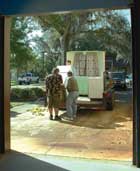
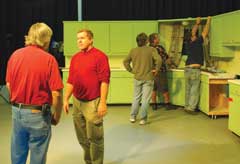
Jim Passanante deftly maneuvers his flatbed trailer with the disassembled set up to the loading dock. On board, awaiting reassembly, is the set. He’s designed, foraged, built and painted the whole thing from scratch by himself in six days – mere child’s play for a guy who once built a New York subway station in an abandoned warehouse for a Die Hard movie (see the sidebar interview). Passanante put the set together so quickly that few involved with this endeavor have seen it. Even before the straps come off and the first piece is unloaded, it is apparent from the slack-jawed expressions that he’s exceeded expectations by a significant margin, like maybe the moon.
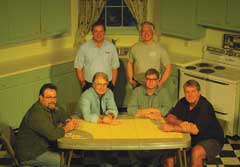
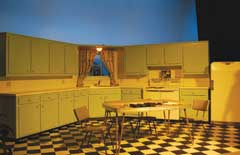
Within forty-five minutes the load-in is done and part of the generic vacuum of the TV studio becomes a sea foam green “nifty fifties” kitchen complete with matching period dinette set, working refrigerator and a checkerboard linoleum floor. I swear I can hear the theme from Leave it to Beaver. The transformation is as stunning as the reality this make-believe thing represents: this is really happening.
A small world story
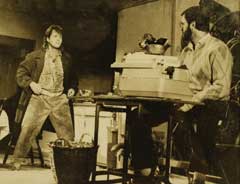
I was introduced to Sam Shepard at the old Poynor Auditorium in Florence back in 1988. True West was the play then, too. I was working for SCETV at the time and ended up shooting a piece on the fledgling theater group – Broad Reach Productions – and the pair of local brothers behind it. Bob and Tom Schuster were siblings on stage, as well. Bob was Austin, the promising screenwriter whose career is beginning to simmer. Tom played older brother Lee, a silver-tongued thief and drifter whose most heinous theft is his kid brother’s big break. I have been a Shepard fan ever since.
Flash forward a couple of decades to Beaufort. Rehearsals are underway in the USCB Performing Arts Center for a production of Arsenic and Old Lace. Evans directs the debut production for the Beaufort Theater Company. There is something strangely familiar about the guy playing Jonathan, Mortimer’s murderous older brother. It doesn’t take long to connect the dots once that voice booms across the theater. During the intervening years, Tom Schuster’s logged more than a hundred stage plays and dozens of film and television roles, sharing screen time with the likes of John Voight, Kathy Bates, Kris Kristofferson and Chuck Norris. “Basically, I haven’t unpacked my suitcase in twenty years,” he says. Based in south Florida, he’s in town to help care for his ailing parents and answers an ad for the audition on a whim. Serendipity.
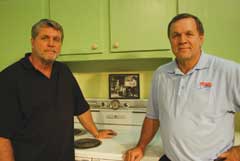
Arsenic is a hit and pretty soon Evans and Schuster are kicking around the idea of doing something on stage together. Evans is eager to be back on the boards himself after a brief hiatus. He’s tackled roles like Macbeth, Iago and Tybalt on both coasts and – like Schuster – he’s no stranger to True West, having filled Austin’s shoes for the Marin Theater Company. In fact, once True West entered the conversation the show practically seemed like fate. Schuster and Evans realized they each had played Lee and Austin, respectively, in practically simultaneous productions on different coasts. Both still shared a passion for it and Tom was available. “We were talking during Arsenic,” he says. “I told Jeff if I’ve got to be here in this town I’ve got to do something I love to do or I’ll go nuts. This is a way to make that happen.”
“I’ve done Shakespeare around the Lowcountry for a long time and always wanted to do something contemporary,” explains Evans. But the choice of the material runs back to his theatrical roots on the West Coast. “Being from San Francisco where Sam Shepard was the playwright in residence at the Magic Theater – where the play was first produced – probably had a bit to do with it. That being said, Shepard is truly one of the great American playwrights and True West ranks among his best work.” The scaled down size of the production made it even more appealing and possible. The entire show takes place in a single setting and the cast numbers four with the lion’s share of the load split between the two leads, in this case, Schuster and Evans.
“It’s about two estranged brothers who don’t have a lot in common,” Evans explains. “Austin is the good son, Ivy League educated with aspirations of becoming a professional screenwriter. Lee is…”
“Danny the tunnel rat,” laughs Schuster. “He’s got issues.”
More to the point, Lee’s a weapons-grade black sheep, a desert rat and drifter whose only good intentions involve himself.
“They both end up at their mother’s house because she’s on vacation in Alaska,” continues Evans. “Austin’s finishing up a screenplay deal with a producer named Saul when Lee shows up and essentially steals his dream.”
Mary Strick, Arsenic’s Elaine, steps into Mama’s pumps for what amounts to a brief walk-on at the end of the play. It’s a sign of shear passion to show up each and every performance for such a fleeting moment, but one Strick approaches as if it were a lead role.
For Saul, the Hollywood producer and force behind the inevitable final clash between the brothers, Evans called in his old friend Leo Gannon.
“So,” I ask Leo, “was this the thespian version of a naval press gang? Did they march through Habersham and conscript you on the spot?”
“Something like that,” He laughs. We’re sitting in the Green Room at WJWJ. “I’ve known Jeff for a long time and he’s always been very helpful to me over the years with a lot of the things I was working on as an actor. He’s been after me to do something since I came back to Beaufort in 2001 and I keep turning him down for one reason or another.”
So what’s different this time?
“I guess I finally ran out of excuses,” he says. “Jeff told me he was doing True West. It’s a good play. I’m familiar with that play and basically saw this as an opportunity to help him out with a role in a production he’s been talking about for at least ten years.”
Gannon first felt the first exquisite sting of the acting bug in 1991 when Barbra Streisand’s production of Pat Conroy’s The Prince of Tides rolled into Beaufort.
“I was on the set as Nick Nolte’s stand-in for six weeks,” he recalls, “which was a real eye-opening experience – my first time on a big time movie set.” Armed with a brand new Screen Actor’s Guild card he picked up enough work and built up enough confidence to move to New York. Just before that move, Gannon needed a last minute audition piece taped for a film role, and called Evans. “That’s one of the reasons I remain loyal to him,” he says. “I didn’t have to ask twice. He shot it, I got the part and I spent the next seven years in New York and the rest is history.”
These days Leo Gannon is a successful builder. He knows a thing or two about solid construction and sees the potential for this production to serve as a foundation for a fresh perspective on the performing arts in Beaufort. “That’s one of the reasons I think so many people are excited about this,” he says. “I really think that this space is the most well-suited space for this kind of thing that I’ve seen in Beaufort, ever.”
Space has always been the unconquerable final frontier for the performing arts in Beaufort. The suggestion to boldly go where no theater production had gone before came from Tom’s brother Bob. “I told them to call Scott Johnson at WJWJ,” he says. “It’s a beautiful studio and they’re not doing anything with it. That afternoon they came out and talked to him.” Bob would know. In addition to handling marketing and public relations for Clemson University, he’s also attached to SCETV’s “Your Day” radio and television programs. This production will be featured on both shows. “It’s a win-win for everybody,” he says. “It gives WJWJ an opportunity so show off what they’ve got. It gives the theater community something to hang their hats on, and it gives these guys an opportunity to showcase their talents.”
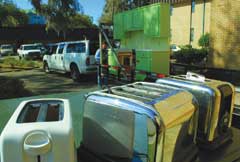
Self-proclaimed “fish out of water” Alex Cooper comes aboard as Production Manager. “These guys have faith in me and I am privileged to be in this company,” she says. Her first order of business is to find the slew of props the actors will destroy each show. “Go find thirty typewriters and toasters these days. Not easy.”
With the cast, crew and venue in place, all that remains is the set when Evans and Schuster bump into Jim Passanante while scouring the Goodwill for props. The play pops up during the course of the conversation, and – once again – serendipity steps in. Passanante’s one of the film industry’s most sought after “Scenics” – master craftsmen who build and paint sets. “I started working at Universal Studios when I was seventeen,” he says. Today the business spans three generations of Passanantes. “My Dad ran the plastering department, my brother was a carpenter, I was a painter, my younger brother was a painter, and my son is a painter.” Passanante’s got more than seventy-five films to his credit with titles like Cold Mountain, Die Hard With a Vengeance and Forrest Gump. He’s just wrapped Robert Redford’s The Conspirator in Savannah and has a little time to kill between gigs. Bingo. The “S” word strikes again. Sam Shepard hasn’t mustered this much fuss since he stole Jessica Lange from Mikhail Baryshnikov.
The Final Frontier
Distilled down to its absolute essence, True West is to sibling rivalry what King Kong is to apes. “It scares some people,” says Schuster, “but if you do it right, it’s hilarious stuff. In the end it’s what most of Shepard’s stuff is about: not really knowing the people you think you know.” It’s also a slow burn between the two brothers that will literally have them at each other’s throats – an idea that didn’t work very well for real life brothers Randy and Dennis Quaid. During the 1982 Steppenwolf Theater Production in Chicago, the Quaid’s onstage conflict erupted into a legendary backstage brawl. Allegedly, the two brothers didn’t speak for years. That same production also launched the careers of Gary Sinise and John Malkovich and solidified the fledgling Steppenwolf as a company to watch out for. Could this production of True West point the way for a new theater company in the Lowcountry? Absolutely, say Schuster and Evans. They’re currently exploring the possibility of taking the show on the road once the initial Beaufort run is finished. Naturally, the next project is already being discussed.
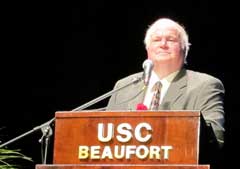
Leo Gannon sums it up best. “There sure are a lot of pieces falling together right now and that makes it exciting.” To paraphrase Tom Stoppard’s Shakespeare in Love, it all seems to work out in the end, although how remains a mystery. However, should this production give birth to a new theater company, I’d seriously consider the name “Serendipity.”
TICKET INFORMATION
True West runs April 9th – May 2nd at ETV Lowcountry, WJWJ-TV 925 Ribaut Road in Beaufort. Show times are Friday & Saturday at 8pm, Sunday’s at 3pm.
Performances run approximately 75 minutes
Tickets are available by calling 843-525-8534 or 843-522-0418 and online at www.lcweekly.com
The Prince of Titles, Part II
Tuesday, 16 March 2010 10:27
A conversation with bestselling author Pat Conroy about his work from the page to the screen
Pat Conroy’s debut novel, The Great Santini was the first film to shoot in Beaufort and the movie that put the state – and the Lowcountry – on Hollywood’s radar. To date four of his books have been adapted as feature films. All but one were filmed in the actual Lowcountry locations so beautifully captured on the page. A few years later (and a lifetime ago) I interviewed Pat for series of reports on the film business I produced while anchoring TV news in Columbia. We talked about his family’s very different reactions to the books and the films (“They adored the movie versions of themselves”) and about sticking to the Lowcountry landscape of the novels (“They couldn’t be filmed anywhere else”). Four years after collaborating with Barbra Streisand on The Prince of Tides, the experience still baffled him a bit. “I did not recognize a single word that I personally wrote in the screenplay,” he said. “Despite that I was nominated for an Academy Award for my work in it. It still remains one of the great mysteries of Hollywood to me.”
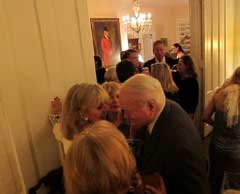
The following interview was conducted by phone a few days after the conclusion of Beaufort International Film Festival where Conroy received the Jean Ribaut Award For Writing Excellence. The 2010 BIFF also reunited Pat with old friends, Blythe Danner and Michael O’Keefe, cast mates in the The Great Santini. The trio attended a cocktail reception in their honor at Tidalholm, the historic house where much of Santini and The Big Chill were filmed.
As Part I concluded, Pat was recalling the day Santini’s infamous basketball scene was shot at Tidalholm. On film the one-on-one match between father and son – taken from Pat’s own experience – quickly degenerates into a family disaster. Behind the scenes something very different begins to happen as the cameras roll...
Mark Shaffer: When I talked to Michael [O’Keefe] in the house where the [The Great Santini] was filmed, he mentioned that both you and your Dad were on the sidelines to watch them shoot the infamous basketball scene.
Pat Conroy: Yes, we were watching that. What a happy day that was.
MS: I imagine that was a little intense.
PC: Dad and I did not have a spectacular relationship at that time and did not realize that the movie was going to help bring us together - he was so enraged by the book. Even [about the scene] in the book he said “I never would have hit you in the head. I’d have knocked your (deleted) head off with one blow from a basketball. You’d have been unconscious if I’d done that.” And I said, “Yeah, Dad, but I had to tone it down so human beings could believe it might actually happen.” We had a million scenes like that. Dad was a nightmare to play basketball against. So what he would do to me, he’d simply slap my face. He would guard me, so first basket [I make] he simply slaps my face. He’d slap me and he’d slap me and he’d slap me. And I’m tired and trying to get away from him and he still slaps me – slaps me on the back of the head. I was looking for a way to convey that in a dramatic fashion, so I came up with that bouncing the basketball off the head. Blythe [Danner] told me Duvall almost killed her by throwing the ball into her stomach. You can see it in the film – you can see it hurt her.
MS: You’re right. I’ve often wondered at that. [Michael] O’Keefe, who took those basketballs to the head, says Duvall just did not hold back, did not pull his punches.
PC: Is that right? Holy crap. Poor Blythe. Some poor woman who had just moved to the Point came up and watched [the filming] with my father and me – and it was a horrible scene to watch being filmed. That’s when I realized that Duvall and Blythe Danner and Michael – these were great actors. I thought, Jesus Christ, these people are terrific.
So this poor little lady is watching this and she comes over and sees my father and says (affecting shocked woman), “Did you play these games often, Colonel?”
(Both laugh)
And he says, (deep and serious) “Every day, madam! Every damn day of my son’s life!” (More laughs)
And so she just stares at him in horror and Dad looks at me and says, “I like that scene.” And I said, “Dad, only you would.”
MS: He was fond of pointing out that he was responsible for Duvall’s career, which really took off after Santini.
PC: Oh, my God. I want to tell you, let me not de-emphasize that. Dad was not exactly a movie buff. I don’t think he even knew what The Godfather was. He did afterwards, he became an aficionado of Robert Duvall’s career. And he gave himself full credit for Duvall’s [Best Actor] Oscar in Tender Mercies. Dad always said that wasn’t half the role he had in Santini.
MS: Duvall showed up in Beaufort fresh from the epic nightmare experience of shooting Francis Ford Coppola’s Apocalypse Now.
PC: Yep. Yeah.
MS: In a way he was already geared up for the character of Bull.
PC: Dad didn’t know “the smell of napalm in the morning” from nothing, but [Duvall] was ready for [Bull].
MS: Did he maintain that intensity off the set?
PC: He was very nice to me off the set.
MS: Did he hang out with your Dad at all?
PC: You know, I think he did. I think there were a couple of times he and Dad went out drinking. I know that I had dinner with him over at Harriet Keyserling’s house. In fact every time I have a [story] in Beaufort where I eat dinner with anybody, I usually have to end it by saying “I had it at Harriet Keyserling’s house.”
(Both laugh) It seems to me that every dinner I’ve ever had with anybody has been at Harriet Keyserling’s house.
MS: Why do you suppose that is?
PC: Well, Harriet just meets everybody. She still does. Did you notice she was at the Tidalholm party?
MS: I did. In fact, I snapped a great shot of O’Keefe bending down to shake her hand.
PC: Having [the party] there was very, very special.
MS: Well, while we’re there, you’ve got a core group of very close old friends – a number of them were at that party. This has to be a remarkable journey for friends and family over the years.
PC: Well, I think it is. It may be painful for some. My sister Kathy was [at the BIFF awards ceremony] and she had a spectacular time. She simply went nuts when Blythe Danner talked about my mother with such fondness. She said it was one of the great nights. For me it was sort of surreal. I don’t know quite what to feel, just like I don’t know what to feel when I see a movie made out of one of my books. I don’t even know what to feel when I see a book made out of a book.
MS: It all still seems extraordinary?
PC: It does just seem extraordinary to me, unreal to me. It was a dream I had in Beaufort High School and I can’t believe it worked!
MS: In your speech you explained that in a way you feel as though you’re still fifteen years old.
PC: There’s no question about that. Here’s how weird my association with Beaufort is: it thrilled me to get the Jean Ribaut Writing Award. One of the reasons it thrilled me is my mother wanted me to try out for a play that was produced in Beaufort when we [arrived]. And I was not even allowed to try out for some reason. It was about the founding of Beaufort and it told the story of Jean Ribaut founding the colony – he was the first [European] to land in Beaufort County. But it tickled me and I called Julie Zachowski, who used to be the librarian and was my classmate in high school. And I said, “Julie, you were in that play.” And she said, “I was an usher.” My best friend was in the play and he lorded it over me because he was in it and I wasn’t. He had a line and I was so jealous I could barely stand it. I said, “Julie, what was the line?” And she said, “Allo! The admiral comes.” (Both laugh)
MS: Think of it this way: had you been in that play it might have meant the pre-emptive end of your life as a writer and the beginning of an acting career.
PC: (Laughs) This I doubt very much. Julie called me last night. We talked for an hour and she gave me the whole cast – all the kids I went to high school with. And the play was called “Prologue to Freedom.” So that’s the association [with Beaufort] that I love.
MS: Throughout your work there has indeed been a very strong association with Beaufort. It’s obviously a very, very special place. You get it and that seems to factor into just about everything you do. [Charleston novelist] Josephine Humphries once told me that in Southern literature place is as much a character as anything else.
PC: It certainly is with me. I have to tell you, when I came here no one told me how beautiful Beaufort was. To Dad it was a base he got to fly out of. Mom had never heard of it. So we come into this town and I can remember my first time riding down Bay Street and the mansions and thinking “my God!” I look out to this river and I’ve never seen anything so pretty in my life. In landscape Beaufort County simply entered my life from the time I got here until now. It just seems prettier than any other place to me and I love writing about it. And, by the way, I lived in the eastern Siberia of “teenagerhood” in Beaufort – I lived in Laurel Bay.
MS: That’s a bit of a haul, particularly for a kid without a car in those days.
PC: My God! I can tell you how much of a haul it is. I’ve been back in Beaufort since 1991and I have never – not one single time – even seen the gates of Laurel Bay.
MS: Wow. Just got your fill the first time around, huh?
PC: I just have no reason to go there. I’d like to see my old house, but I’m not sure they’d let me through the gates.
MS: Oh, I’m pretty sure they would.
PC: (Laughs) Now that I think of it, I’m sure they would. But who would I call to set it up?
MS: My guess is that if this makes the final edit, you’ll get an invitation.
(Laughter) Back on the subject of your work, any possibility that more of it will make it to the movies?
PC: Yeah. Allan Ladd, Jr. bought Beach Music. He’s had that. And somebody’s talking about South of Broad now. I usually don’t have anything to do with that. They just tell me about the negotiations. Somebody just [secured the rights for] The Prince of Tides to do a regular TV series – which I never thought of. My Losing Season was bought by Brad Pitt – he owns that one. And of course when my daughters – my rude, poorly raised daughters – found out that Brad Pitt might play my part, they sank to their knees in helpless laughter.
MS:(Laughing)
PC: So I cut them out of my will.
MS: (Still laughing)
PC: They scream with laughter every time the thought crosses their minds. But I think Brad’s let himself get a little too old for the role.
MS: That should be a hot property. That sort of lesson-learned sports genre is big now with the success of The Blind Side.
PC: I didn’t see it. I read the book. It was terrific.
MS: Another one that got away, another big hit shot next door in Georgia.
PC: South Carolina has to change the rules. If they can get a movie made in this location it is going to bring benefits for the next hundred years to Beaufort. I hear things like Cold Mountain was mostly shot in Romania? And every movie in the world was made in Canada in the ‘90’s, I think. Something’s got to be done. They’ve got to make it easier, they’ve got to make it less expensive for these films to come here.
MS: The powers that be in Columbia can’t seem to process that. We just don’t have the incentives anymore to compete for big budget films with the likes of North Carolina and Georgia. Which means the odds that any of these projects of yours would film in this state are slim to none. How does that make you feel?
PC: It wouldn’t be a movie made from my book, I can tell you that. It just wouldn’t be. Nothing any of these legislators can do will have as lasting an impact on tourism, on business – on anything else – as getting a movie made in South Carolina.
Email Mark Shaffer at
This e-mail address is being protected from spambots. You need JavaScript enabled to view it