If you’re lucky enough to live in the Lowcountry, every day is a vacation waiting to happen. Follow us over the river and through the marsh…
Lowcountry Lens
Wednesday, 26 May 2010 12:16
Professional photographer Eric Horan sheds some light on gearing up for the perfect shot and why he prefers his in the RAW.
“It’s not the camera. It’s what you do with it, what you put in front of the viewfinder.”
- Eric Horan
Mark Shaffer: We live in one of the most photographed towns on the east coast. So for all the amateur photographers wandering around the Lowcountry snapping away at the wildlife and the scenery, what’s the key to taking good pictures?
Eric Horan: That’s a wide open question with a lot of variables – the type of camera, the lighting. A lot of people aren’t going to bother to learn a lot about their camera and just leave it on “auto.” So the best thing for them is to learn about composition – composition and lighting – because they’re going to rely on the camera to figure out all the exposure stuff. Then they’re going to go out when the light is better and if they know something about composition they’ll benefit from that.

Besides lighting and composition there’s exposure. When you tackle exposure you’re tackling the nuts, bolts and the guts of photography – F-stops and shutter speed and how to override your smart camera – which is smart about 90 percent of the time and messes you up the other 10 percent.
MS: I find that I rely on the automatic functions too much.
EH: As far as exposure, the cameras are pretty smart. If you’re shooting landscapes the camera knows that you need enough depth of field to deal with it. But you can’t alter the process if you don’t know anything about it.
For people who want to learn how to have a bit more control over how their pictures come out, learning F-stops and shutter speeds and the relationship between those two is important. Even if you don’t shoot in Manual, learn to shoot in Aperture Priority mode or Shutter Priority mode because that way you’re picking what’s important to you. The camera will pick the other value but you know how to alter and adjust that if the camera’s not giving you what you want. If you need a 500th of a second to stop the action and the camera’s saying “Okay, let’s shoot F8/500” but you would rather shoot F11 because it’s over-exposed, you need to learn how to use the Exposure Compensation button. Quickly with your thumb add “plus one” and shoot what you want. I recommend that everyone learn the auto modes, learn Aperture Priority and Shutter Priority and pick the one you like best.
MS: Which do you prefer?
EH: I shoot Aperture Priority. I’ve been doing it so long I know what the shutter speed’s going to be. That way I don’t have to switch modes. I always shoot in Aperture priority and compensate with the Exposure Compensation Button. There are some situations where I’ll shoot in Manual, but that’s two adjustments while in Auto Mode it’s one adjustment.
MS: When you’re out on the river photographing birds, for instance, how much fiddling with the camera are you actually doing?
EH: Quite a bit. Your camera meter is turning everything into neutral grey. If you have a white bird in a landscape it’s going to be over-exposed. If your meter is seeing just the white bird, it’s going to be underexposed because it’s turning that white bird grey. You have to know those situations. I tell everybody to do test shots before they get into the heat of action. If you get into a situation where you’ve got all this stuff going on and you haven’t figured out your camera functions, you’re not going to get the results you’re after. But if you make the time to do some test shots and do the evaluation with the histogram-
MS: You see, when you start talking histograms that just scares the crap out of your average technologically challenged guy like me.
EH: Well most of these cameras now, you don’t even have to know the histogram. They have clipping indicators for the highlights and the shadows. The camera will flash blue in all highlight areas and red in all the shadow areas to show you what you’re missing as far as pixels. And you can make those up and down adjustments with the Exposure Compensation button based on these flashing things. You don’t really have to know the histogram. It’s just a more accurate way to read it.
MS: It’s all about histograms and pixels, which brings us to software because we’re processing it all on the computer. As a pro you use Photoshop. What about the rest of us?
EH: Adobe makes the best [photography] software and most people don’t need the big expensive edition. Photoshop Elements is about a hundred bucks and Elements is great. It does almost everything you’d ever want. [Photoshop] Lightroom is one step up from Elements at about three hundred bucks and literally does everything that 95 percent of photographers would ever need to do including file management and archiving.
MS: This is beyond the needs of the casual photographer. This is serious technology for real manipulation of the data.
EH: It will do anything you need it to do. And with those programs there’s room to grow as you learn more about your camera and take a more active part in exposures and all that stuff.
MS: I’m a Mac, so one of the programs I’m considering is Apple’s new and improved Aperture III.
EH: Lightroom is a better program. Aperture’s come a long way, but Lightroom was made by photographers for photographers. It’s better than [the full] Photoshop for that reason because Photoshop was created by graphic designers.
MS: There’s also a lot of free stuff out there that’s pretty good and getting better. I still use Picasa (a free download from Google) because of its simplicity – and because I’m processing JPEGs.
EH: It’s good and it’s free. And if you’re going to shoot JPEGs and rely on the camera to do a lot of the work, then something like Picasa’s fine. But as soon as you discover the advantages of shooting RAW, then you’re going to have to graduate.
MS: Simply put, JPEGs are normal digital images processed by the camera. A RAW image is exactly that: raw data.
EH: It’s kind of like a negative and very few photographers could read negatives – the colors are weird, images are reversed. Your camera is taking a RAW file and making a JPEG based on whatever technology the camera manufacturer uses. So the camera is giving you its best shot for a processed RAW file. Once it’s processed that JPEG file you can’t go back to RAW. In RAW you might have a 20 meg file and the camera’s giving you a 9 meg JPEG. You can never get those 11 megs back. All that information is thrown out. So if the picture doesn’t have the correct exposure or color balance, that information’s just gone. RAW gives you the ability to get all that stuff right in the processing. There’s a lot more latitude in what you can get out of a RAW file. With JPEG you’re stuck with whatever the camera’s giving you.
MS: But JPEG is still the mainstream format because it’s simpler, eats up less memory and doesn’t require special software?
EH: RAW is more work. There’s more of a learning curve. When you start shooting RAW you have to know how to read a histogram, you have to know how to do the processing. It opens up a whole new can of worms.
MS: For those of us who remember the darkroom, sometimes it still seems fantastic that just about anyone can explore photography as long as you have a camera and a computer.
EH: I think that’s why the camera clubs are going crazy – they’ve quadrupled membership in the last few years. I think a lot of people who shot film are turning to digital and a lot of new people are getting into it because of the digital stuff and how smart the cameras are. It’s hurt the professional market, too, because the cameras are so smart and anybody can go out and get a decent shot with a good camera.
MS: Sure, but 99 percent of them aren’t going to go out and do what you do.
EH: No, probably not.
MS: The average Joe’s not going out with a 500mm lens-
EH: And stand on a ladder in a boat -
MS: Not likely. So let’s talk hardware. These days buying a camera is a little like buying a car – new models come out every year, the technology changes so fast – things are practically obsolete out of the box.
EH: If you buy as top-of-the-line as you can it’s going to last longer than an entry-level camera. Spend as much as you can afford. For instance if you’re looking at Canon, you can still get the 40D but it’s going to be a paperweight in two years. If you get the 7D it’s probably good for ten years. As far as lenses go, that depends on what you want to do, what you’re willing to carry and what you can afford.
MS: The last time I was in Zion National Park I watched a pretty funny exchange between a pro photographer and a well-financed amateur. They were both schlepping around a ton of gear, but the amateur had better gear than the pro and more of it.
EH: You wouldn’t believe some of the people who get on my boat. They have so much gear it’s unbelievable and I’m like, “can I borrow that?”
(Laughter)
They’ve got stuff that’s been on my “wish list” for years. And there again, they usually only need a small fraction of that stuff in the boat because you’re limited to what you can do.
MS: I wouldn’t think swapping out lenses every five minutes is a good thing to do in a salt breeze.
EH: (Laughs) No. When I teach nature photography I always tell people they’ve got to pay attention to what’s going on in the field.
MS: Operating the camera needs to be second nature.
EH: To a degree. If you’re still trying to figure out F-stops and shutter speed when you should be shooting, you’re going to miss a lot. And believe me, my list of things to shoot is a lot longer than the list of things I’ve been able to shoot. People ask, “What’s your favorite image?” And I always say it’s one I haven’t shot yet, for sure.
The Backyard Tourist hits the water for an extraordinary photo safari with Wildlife Photographer Eric Horan
The artist's world is limitless. It can be found anywhere, far from where he lives or a few feet away. It is always on his doorstep.
- Paul Sand
Close Encounter
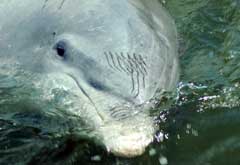
“You’d think with a propeller scar like that she’d stay away from boats,” says Eric Horan.
I spotted this trio of bottlenose dolphin cavorting near the Chechessee River Bridge just before Eric showed up with the boat – two adults and an infant. Thirty minutes later they circle the boat to check us out. One of the adults and the youngster maintain a discreet distance never coming closer than a few feet. The other adult is more gregarious. She’s obviously had an unpleasant encounter with a boat at some point. The scars on her forehead and snout form a series of interlocking vertical “Z’s,” certainly evidence of a painful and traumatizing injury. And yet here she is right alongside the skiff skimming by the port side rail, her sleek grey head half out of the water, eye’s sparkling with intelligence and curiosity – and maybe even looking for a snack.
My adrenaline is pumping as I scramble around the bow trying to accomplish the photographic equivalent of shooting a fly with a howitzer. I’m packing my DSLR, a slightly dated but normally reliable Nikon D80. I’ve borrowed a 300mm lens and a piece of optical augmentation called a Tele-converter (in this case a “doubler”) in anticipation of taking a lot of shots from a distance. And this is my current dilemma: while the dolphin swim within feet and sometimes inches of the boat, I’m clinging to the farthest reaches of the bow trying to put enough distance between
subject and camera to allow my 600mm-worth of lens to focus. I am a greenhorn i
n this situation, an adrenaline-hyped rookie furiously snapping away – one eye in t
he viewfinder, the other on my feet, desperately trying not to fall in. Like a panicked gunfighter I am so caught up in the moment trying to get a decent shot off with the big gun that I’ve completely forgotten about the “hideaway” in my pocket, a compact Canon S90, perfect for this situation. It will be a good thirty minutes before I realize this. It will not be my first or last rookie mistake on an otherwise glorious day. But as Eric is quick to point out during the course of the afternoon, it’s all a learning process.
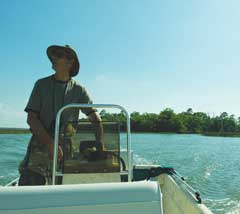
This is a day at the office for Eric. And what an office it is. The spring sun is high and bright, the pale turquoise sky is flecked with wispy confections of bouffant clouds. The relentless insistence of wind and tide make handling the skiff a challenge, two factors that nearly always determine a point of departure. “Something I learned from experience,” says Eric. “Any photo outing is ten times more complicated on a boat. Then again, it can be ten times more fun.”
I count only two other boats the entire afternoon as we cruise among the creeks and inlets of the Chechessee and the Broad Rivers. One has the unfortunate timing to show up as Eric spots a bald eagle perched in the gnarled top of a dead tree on a tiny marsh island. “That’s a great shot if we don’t spook him,” says Eric with typical understatement. I can tell that even the old pro’s excited. Even if this is a fairly typical day at the office for a wildlife photographer, this is not a typical opportunity. It’s a perfect shot: an adult bald eagle facing the afternoon sun framed against a gorgeous sky and perched on a craggy old oak limb, to boot. “You might want to start shooting,” he advises. “You never know, and something might be better than nothing.” Right on cue the bird takes flight as I click the shutter. I fire away to no avail. A moment later another skiff breaks out of the Spartina grass and speeds past. It will be the only boat in our immediate vicinity for hours. “That’s okay,” says Eric, “I’ve seen him feeding in a creek just over there. We’ll see if we can find him a little later.” In a nutshell, this is the advantage of going out with a professional. Chances are even if you don’t find exactly what you’re looking for, you’ll find something else. Or something else will find you.
The Breathtaking Chaos of Flight
I first met Eric Horan a couple of years ago. Shortly after washing up on these shores he was kind enough to invite me along to photograph wood stork and snowy egret nests on an old plantation site in Yemassee. My camera was brand new (I’d barely glanced at the manual), and I was deeply inexperienced in this sort of setting. But by day’s end I was hooked – and what’s more, I was a better photographer, albeit by increments. I still have one of those shots on my wall: a mother egret stands over her downy brood, wings fully extended, each delicate feather detailed and backlit by the waning sun behind her.

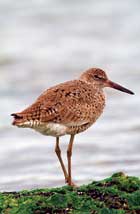
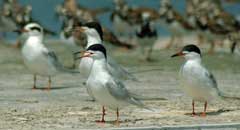
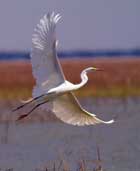
Today the river and marsh team with birds. Forester’s Terns hang like dainty kites above the water, spying bait fish and knifing in and out of the water with elegant precision. Willets stalk the marsh grass in perfect camouflage while their cousins – Spotted Sandpipers – zoom ahead of the bow like tiny heralds of our arrival.
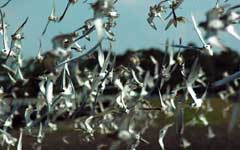
Ruddy Turnstones mass on a deserted dock. On a rocky beach it would be easy to mistake their textured shades of brown and white for stones, indeed. The flock leaps into the air in unison, an explosion of white under-bellies then the flash of auburn wings as they bank and turn.
Flocks of terns repeat the process, sometimes mingling with turnstones and other birds. They appear to move in unison like a single entity. “It looks like they’re all moving in perfect sync,” says Eric. “But if you can capture it in a photo, you can see they’re all doing the best they can not to crash into each other.” One of my favorite shots from the day captures a split second of wild maneuvering as a tightly packed flock of gulls, terns and dunlins take to the air. To the naked eye the birds appeared as one. The camera reveals the breathtaking chaos of flight as the individual birds execute intricate aeronautical adjustments.
Post Script
Over the course of four hours we tally an impressive list of photo-ops. The eagle eluded us, but there were many dolphin encounters, though none as remarkable as the first. We witnessed a sort of air-to-sea feeding frenzy as egrets, gulls, terns gorged on baitfish plucked from the marsh’s edge, and dive-bombed the shoreline like tiny, feathered Stukas. And on a secluded oyster bed at the convergence of tidal waters we photographed an American Oyster Catcher as she patrolled her private beach, clearly concerned with a potential security breach. “I think we’ve bothered her enough,” Eric says, picking up on the bird’s growing agitation. Minutes later we’re back on the Chechessee headed for home, squinting against the glare of the setting sun.
Eight hundred forty-nine photographs. That’s what I fired off during the course of four hours on the water. And here’s the hard lesson: of almost 850 photographs more than 90 percent were rendered completely useless in-camera. Most of the photographs I took that day ended up on these pages only after a monumental salvage operation by Lowcountry Publisher and Photoshop wiz, Jeff Evans. An exhaustive internal investigation turned up a bunch of old phone books, a petrified slice of half-eaten pizza and the theory that a combination of the borrowed Tele-converter and something called “operator error” are probably to blame. As Eric would point out “It’s all a learning process,” and once again I will be a better photographer because of it.
Book your own photo safari or wildlife tour with Eric Horan at www.southernlight.biz
or by phone at 843-524-3037. Email story ideas to Mark Shaffer at
This e-mail address is being protected from spambots. You need JavaScript enabled to view it
Lord of the Rings
Tuesday, 11 May 2010 20:12
World-renown Dendrochronologist, Henri Grissino-Mayer, uses the science of tree rings to map the past, expose historic frauds and even put a murderer behind bars.
Permanently Stumped
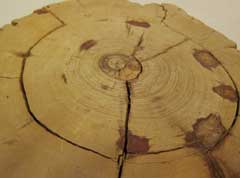
Dr. Henri Grissino-Mayer loves tree stumps. For one of the world’s foremost experts in deciphering the language of tree rings, or dendrochronology, a well-preserved stump is the story of ages and sometimes even millennia. “Trees are nature’s ultimate recorders of what goes on in the environment,” he tells the rapt audience. Mclean Hall at the Technical College of the Lowcountry is filled with professional arborists, foresters and tree lovers of all types for the B3C Tree Symposium. “Trees can talk. I just try and interpret what they say.” The head of the University of Tennessee’s Laboratory of Tree Ring Science is to dendrochronology what Indiana Jones is to Archeology, only minus the bullwhip and fedora.
His lengthy list of academic achievements includes the development of a 2,200 year long reconstruction of annual rainfall for the American Southwest. His lab in Knoxville is routinely inundated with pleas by historical groups and private individuals to scrutinize everything from old buildings to priceless musical instruments. The curators of England’s Ashmolean Museum at Oxford brought in Grissino-Mayer to examine the legendary Stradivarius violin known as “The Messiah” after questions arose regarding its authenticity. Ostensibly made by the master Antonio Stradivari in 1716 and valued at around twenty million dollars, the violin was taken out of its glass case for the first time in more than a century. “I didn’t core it,” Grissino-Mayer jokes. What he did do was dispel any question about the instrument’s authenticity by mapping the tree rings in this most rarified piece of wood. The museum was thrilled.
An American museum claiming to own the log cabin in which Abe Lincoln was born was not so thrilled. Grissino-Mayer’s lab dated the exposed logs a half century later, closer to his presidency than his infancy. Like Honest Abe, says the scientist “Trees do not lie. Just read the rings correctly.” A similar job for the Tennessee Historic Commission revealed a 1787 blockhouse, thought to be one of the oldest structures in the state, to be a hog barn built in 1860.
“How’d you know it was a hog barn?” asks someone in the audience.
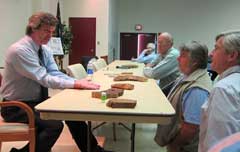
“It smelled like pork,” he deadpans.
Dr. Grissino-Mayer and his grad students have been featured in documentaries and programs on the History Channel, Discovery, the National Geographic Channel and Court TV. In 2004 the lab applied forensic dendrochronology to help catch a killer. Rachelle Tolleson was a 20 year-old mother abducted from her Texas home, raped and murdered.
“The killer had tried to burn her body with wood,” explains Grissino-Mayer, “but he hadn’t succeeded.” The night of the murder witnesses at a party saw the suspect toss wood on a bonfire – wood that didn’t burn. Investigators wanted to know if Grissino-Mayer’s lab could match the wood from the crime scene to the wood recovered from the party fire.
“The wood [from both fires] was from the same damn tree!” He says.
It was also the first time tree ring science had ever been applied to a murder investigation.
“A very satisfying case” says the scientist.
The Conversation
Mark Shaffer: It’s official. I now want to be a dendrochronologist in my next life.
Henri Grissino-Mayer: I love, love what I do. Trees have always been my first love. That may be the reason I’m not married.
MS: Well, we know from your presentation that you do spend a lot of time hugging them. (Laughs)
HG-M: I do.
MS: What put you on the path to dendrochronology?
HG-M: I was interested in learning about the past environment when I was an under-grad at the University of Georgia. And I wanted to learn the different techniques to read past environments like ice cores, lake sediments, things like that. Then someone told me about a guy who studies tree rings. This was 1985.
MS: At that time this science is still in it’s infancy on the east coast.
H-GM: Exactly. And so all of a sudden there’s a professor – David Butler – at UGA who was trained out west and he said “Henri, you should do tree rings. I’ll teach you how to do tree rings.” I’ve been hooked ever since. I was amazed at the amount of information you can get from tree rings and the accuracy of that information: earthquakes, volcanic eruptions, drought, frost events, insect outbreaks – I could go on and on. All of this leaves a signature in the tree ring record and all we do is try and find that information in the rings.
David’s now at Texas State University in San Marcos. I just saw him last week up in Washington, D.C. He’s still one of my best friends.
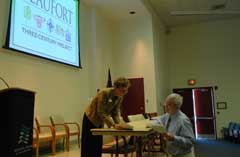
MS: You mentioned during your presentation that even with the recent growth of dendrochronolgy in the Southeast, there is no lab in South Carolina. How would the state benefit from a program like yours?
HG-M: Well, several things. I have to turn down so many opportunities to analyze trees or date an historic cabin – things like that. I have to turn them down. Despite the number of labs we now have in the Southeast, the demand is far out-pacing the number of people who can do the work. As tree ring science becomes better known in the Southeast, we just get bombarded with requests. I get asked to date a log cabin once a week. I get asked to date a musical instrument at least once a month. I get asked to conduct a project for Fish & Wildlife or the National Park Service at least twelve to fifteen times a year. I have to say “no” to most of those. Having somebody here in South Carolina would certainly benefit the state. For one thing, there’s so much opportunity to do this type of tree ring work and to learn about the ages of the trees, the historic significance of many of these trees – especially here in Beaufort. Imagine if you had a tree ring lab in Charleston or Columbia at the university.
MS: I’d think this would be a perfect fit at Clemson.
HG-M: Which is a big forestry school. In fact one of the first projects ever done here in the Southeast – back in 1975 – was conducted on short leaf pines in the Clemson forest.
MS: You mentioned in your presentation that we know relatively little about live oaks. I find that stunning considering it’s cultural significance.
HG-M: Isn’t that stunning? It is the most majestic of all oaks. It has no rival. And here in the Lowcountry it’s so strange that we know so little about the ages of these trees. One of the first trees I ever cored was a live oak – a dead one – on Cumberland Island National Seashore in Georgia. It was also the first bore I ever broke in a tree because the wood is so dense. You cannot core a live oak. It will break your five hundred dollar instrument.
MS: Apparently samples are hard to come by for one reason or another. But you have a couple from the Lowcountry including one that Michael Murphy had cut and Deborah Johnson personally delivered to your lab.
H-GM: I remember dating it and I think it had about a hundred and eighty rings. It wasn’t one of the biggest, though. I’ve dated four and the oldest was about a five-foot section that was about two hundred years old. But eventually you’ll have the data Michael’s been collecting on height and diameter and eventually if we can create a database. What we need are more people like Mike and Deborah who can send us samples from downed trees.
MS: One of the reasons you don’t get more samples is that the various commercial lumber interests horde the wood. How do we build the database if we can’t get the samples?
HG-M: I think any tree management program – particularly in an urban environment – should have some sort of provision that provides sections for scientific purposes should trees topple or have to be cut. That should be in every tree ordinance program.
MS: These trees are sold off for lumber, chopped into firewood or they just simply rot away. So, that’s a challenge. But as you’re finding out, you hit town in the middle of a tree management controversy and we’ve got some big challenges here. What are your thoughts on where this town and this region are on dealing with our big trees?
HG-M: My feeling is that the trees should be preserved as much as possible with little interference from people when it comes down to it – as little interference as possible. You can fertilize and the like, but I’m very much against other tree management options.
MS: Like aggressive pruning, courtesy of the power company?
HG-M: Exactly. I’m not going to question why these things had to be done but I do know that this is not the only community where there’s been a controversy. In my hometown of Athens, Georgia, with their majestic oaks there was also controversy about pruning these beautiful, beautiful trees that had been around since before the Revolutionary War. And many of them did not make it. This was about twenty-five years ago and we’ve learned a lot since then. There is no easy answer when it comes down to it. For one thing, I like electricity. I like my air conditioning. On my street in Knoxville [the power company] just came down the street and took out one whole side of the tree line with a big saw. It’s tragic. It looks terrible now.
MS: And they’re not supposed to do that, but it happens a lot. And it seems to have a lot to do with contractors and sub-contractors, not tree management. There’s real concern here that we’ll lose some of our famous canopies if something’s not done.
HG-M: It’s really a shame and I understand that there’s no easy answer. Why not just move the power lines?
MS: Money.
HG-M: It’s always cheaper and easier to prune beautiful trees rather than move some power lines. But I can guarantee you that those trees have been there a lot longer than those power lines. Why not bury the lines? We’re doing more and more of that in Knoxville. I spent nine years in Tuscon, Arizona. Everything’s under ground, there are no power lines and it’s beautiful.
MS: What are some of the neatest discoveries you’ve made?
HG-M. There are so many and every project I work on has a story. I love stories. I love being involved in something even when it’s controversial. My philosophy is that I’m not doing good science unless I make someone mad. I tell my students, “You’re not doing good science unless you piss someone off.” That’s the truth and the reality is the truth hurts sometimes. One of the most satisfying things I’ve worked on was the Rachelle Tolleson [murder] case. I never knew a project could affect me so much.
MS: To the best of you knowledge is that the first time dendrochronology has been used in a murder case?
HG-M: Yes. In fact, it became an episode of Forensic Files and it’s been highlighted several times on TV. As far as the biggest “Eureka!” moment, it’s a piece of wood that I collected on the lava flows of New Mexico that we’d been walking over for about three years. On the last of seven trips we collected it and I’ll be darned if it didn’t break what we call “The B.C. Barrier” – to actually find a piece of wood that pre-dates Jesus Christ. This to me is one of those spiritual moments. I’m very Christian and when I find a piece of wood like that I go “Wow! This means much more than just the tree rings.”
Get more Lowcountry online at www.lcweekly.com and look for us on Facebook.
Live Oak Legacy, Part Two
Tuesday, 11 May 2010 15:49
Editor’s note: The Beaufort Three-Century Project presented "Beaufort’s Live Oak Tree Legacy and Community Forestry: Past, Present & Future—A Symposium" Thursday, April 29, in the MacLean Hall auditorium (Building 12) at the Technical College of the Lowcountry. The program – unprecedented in the area – included local and international experts including Dr. Henri Grissino-Mayer (see accompanying interview), one of the world’s foremost experts in the field of dendrochronology (tree rings).
“We were very fortunate to be positioned to bring this level of scholarship to the community through these fascinating presenters—both those among our local experts and those we invited to Beaufort for this special program,” says B3C Project Coordinator Deborah Johnson. “The grant from the SC Forestry Commission certainly helped add credibility and it along with the generous in-kind donations let us keep the registration fee as low as possible to encourage broad participation.”

Dr. Kelby Fite of Bartlett Tree Research Laboratories spoke about preserving and caring for large trees. Liz Gilland of the SC Forestry Commission addressed the importance of community forestry (a timely local subject) while the Clemson Extension’s Laura Lee Rose clarified the proper planting methods for Lowcountry trees. Symposium co-coordinator Michael Murphy opened the presentations with his year-long study of the area’s largest and oldest live oak trees.
Of all man's works of art, a cathedral is greatest. A vast and majestic tree is greater than that.
- Henry Ward Beecher, Proverbs from Plymouth Pulpit, 1870
If trees could talk…
Michael Murphy is an arborist, not a comedian. But as arborists go, he’s a pretty funny guy. He’s the lead-off hitter on the program, presenting the much-anticipated results of his year long survey of Beaufort County’s live oaks, a project form which this symposium ultimately grew.
He opens up with a story allegedly told by the brother of a state politician. While standing on the edge of the Grand Canyon, in absolute awe at the shear spectacle of Nature’s handiwork he’s barely able to sum up the experience with a monosyllabic, “Wow.” A total stranger standing next to him says, “Sure. But have you ever seen the sun set on the Bluff in Beaufort?”
Of course, Murphy reminds the room, the involvement of a politician in this story lends a somewhat dubious nature to its authenticity. The crowd laughs, but the point’s well made.
“Life in the Lowcountry,” he says, “requires a sense of everyday awe.”
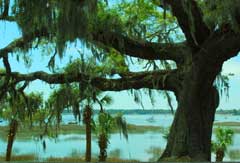
It is that sense of everyday awe that attracts so many visitors to our region. Indeed, it has attracted a good many residents as well (yours truly included). A great many things factor into this wonder – all part of the convergence of land and sea, saltwater and fresh, sky and marsh. But perhaps nothing is as ubiquitous as the sweeping expanses of our regal live oaks. Our history has played out beneath their branches. Bluffton’s Secession Oak and the Emancipation Oak on St. Helena Island bear eponymous witness to events that shaped the nation. But for all of our association and identification with the live oak, we still know surprisingly little about it. And the trees do not give up their secrets easily as Murphy ultimately discovered.
During his twelve month quest for the county’s most impressive oaks, Murphy and his Preservation Tree Service crews catalogued one hundred and thirty-six trees and have yet to set foot on any of the vast area controlled by the military. What he hoped to find – something on the order of the Angel Oak near Charleston – has so far eluded him. What he did find were a lot of big trees, most with stories, some with historical references. A journal entry confirms a tree known as The Graveyard Oak was already a giant two centuries ago. The remnants of an ancient tabby wall are strewn beneath the sprawling canopy of an oak known for countless generations as The Trading Tree. Once slaves were “traded” in its shade – if trees could talk, indeed.
Still the question of just how old these trees actually are will likely remain unanswered for some time to come. The only really accurate way to date a live oak is to cut it or core it, something any ethical arborist or forester is loathe to do. “Like a mysterious woman unwilling to reveal her age, we know that they are old,” says Murphy. “That is the one thing we can agree on.”
And while Murphy hasn’t found his Angel Oak – yet – he did find a tree bigger than the Angel Oak, but without that tree’s famous expanse. Its trunk measures nearly nine and a half feet in diameter while the Angel Oak is just over eight feet. This colossus lords over a forgotten corner of the Cherry Hill Plantation in Burton, the scars of old lightning strikes burned into its limbs. This is one of two privately owned sites available to tour by special arrangement at the conclusion of the symposium. The other – an historic farm site on the bluffs of the Broad River – boasts half a dozen similarly sized trees near the old house.
This afternoon I drive out with my friend and colleague Richard Brooks to see the trees. Being cynical jaded old journalists we are not easily impressed. Right. We spend the better part of the next two hours slack-jawed and humbled in that very palpable sense of everyday awe.
If a man walks in the woods for love of them half of each day he is in danger of being regarded as a loafer. But if he spends his days as a speculator, shearing off those woods and making the earth bald before her time, he is deemed an industrious and enterprising citizen. - Henry David Thoreau
If Trees Could Scream…
The timing couldn’t have been any better. In the days leading up to the April 29th B3C Tree Symposium, Beaufort’s trees were under attack. Literally. Crews contracted by South Carolina Electric & Gas were busy shearing a wide swath through the oaks to clear space around power lines. There were just a few problems, though. Parts of North Street, Ribaut Road and others began to resemble logging camps. Massive portions of the canopy were hacked away. Some of the crews didn’t seem to know what they were doing. “This isn’t tree management,” observed a friend. “This is mutilation. This is tree mismanagement.” When queried by a local landscaper familiar with trees and process, one crew foreman admitted he didn’t even know which species his men were cutting or the proper way to prune it.

Things got heated and confrontational. Mayor Billy Keyserling called a special town meeting the day before the symposiumto address the issue. Many of the attendees of that meeting also took part in the symposium the next day where the issue of tree management was the topic of discussion.
“Although this symposium has been in the planning for about a year and the date set for at least 6 months, it was certainly timely as we ‘talk trees’ all across the county,” says Deborah Johnson. “The audience participation was strong with good questions and dialogue. We were delighted to see so many elected officials, city and county employees, board and commission members. It bodes well as we make decisions about our treescape for the future.”
So how do we ensure that this sense of everyday awe survives into that future?
“There’s a saying that the best time to plant a tree was twenty years ago,” says Michael Murphy. “The second best time is today.”
Get more Lowcountry online at www.lcweekly.com and look for us on Facebook.
Mark Shaffer’s email is
This e-mail address is being protected from spambots. You need JavaScript enabled to view it
Live Oak Legacy: Part One
Wednesday, 28 April 2010 14:12
The Backyard Tourist has it made in the shade...
Editor’s note: The Beaufort Three-Century Project will present Beaufort’s Live Oak Tree Legacy and Community Forestry: Past, Present & Future—A Symposium from 8:30 a.m. to 3:00 p.m. on Thursday, April 29, 2010 in the MacLean Hall auditorium (Building 12) at the Technical College of the Lowcountry located at 921 Ribaut Road in Beaufort. Three optional tree tours will be offered following the program, including a guided tour of trees located on private property not usually accessible to the public. The registration deadline for the event has passed, however, last minute inquiries may be made by calling Deborah Johnson at 843-489-1711.
A tall tale
The tree, which moves some to tears of joy, is in the eyes of others only a green thing that stands in the way. Some see Nature all ridicule and deformity and some scarce see Nature at all. But to the eyes of the man of imagination, Nature is Imagination itself
- William Blake, 1799, The Letters
One wonders what Blake might have made of a canopy of giant live oaks all dripping in Spanish moss, dancing in the breeze like widows’ dreams. I like to imagine that as Blake penned those thoughts more than two centuries ago some of the trees that awe us today were already amazing the locals. Rediscovering and documenting this living history has been a passion project for arborist Michael Murphy these last twelve months. He brought the idea of a comprehensive tree study to B3C Project Coordinator Deborah Johnson. “She had a call out for projects to help Beaufort transition into it’s fourth century,” says Murphy. “And the age of our trees has always been kind of a grey area and one that people are interested in.” Apart from running his business, Preservation Tree Care, Murphy’s spent the better part of a year wrapping his measuring tape around the trunks of some of the oldest and largest trees in the state. He’ll present his findings during the landmark B3C symposium.
The event brings together a stellar list of experts, each presenting in a distinctive area of expertise including internationally known biogeographer and climatologist Henri Grissino-Mayer from the University of Tennessee. Dr. Grissino-Mayer’s expertise in deciphering tree ring data (dendrochronology) has been featured in documentaries shown on the History Channel, the Weather Channel, National Geographic Channel and others. An episode of Discovery’s Extreme Forensics followed Grissino-Mayer and his students as they used forensic techniques to analyze wood fragments collected as evidence in a murder case. Their findings resulted in a very CSI-like arrest and conviction.
Grissino-Mayer breaks down the science of dendrochronology as well as the value of old, historic trees in the United States. Joining him on the program are: Kelby Fite, an arboricultural researcher for Bartlett Tree Research Laboratories speaking on large tree preservation; Liz Gilland of the South Carolina Forestry Commission, discussing community forestry; and Laura Lee Rose of Clemson Extension, presenting on local tree planting. Like one of those big oaks, this all sprang from the nut of Murphy’s simple idea. “Originally the main focus of this whole project wasn’t to have a symposium,” he says, “it was to see if we could find a tree that may have had early settlers beneath it three hundred years ago.”
It is not so much for its beauty that the forest makes a claim upon men's hearts, as for that subtle something, that quality of air that emanates from old trees, that so wonderfully changes and renews a weary spirit.
- Robert Louis Stevenson
Made in the shade
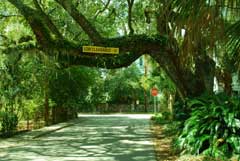
When I was a boy I was certain the great oaks that canopied the various streets of my hometown were of a species known as “shade.” That’s the name I heard most growing up, “shade tree.” Southerners who can recall the novelty of “conditioned air” know this term. Even within our hermetically sealed, climate controlled homes, true Southerners still value a good shade tree, and, in these parts, live oaks make the best. They spoil us with prime shade – a damn fine commodity with which to be spoiled once summer’s screen door to hell opens. Long stretches of roadways rarely glimpse the sun once spring arrives, veiled in gnarled canopies of oak. Visitors to the old historic neighborhood of The Point in Beaufort marvel at the expanse of the live oak that lords over The Castle – barely an above average specimen, according to Murphy. In fact, there are few things as synonymous with the Lowcountry as these moss-draped giants. Some of them are even kind enough to bend a limb low for a weary traveler to perch on and take shelter from a sultry summer’s day. Like Blake, it is difficult to stand dwarfed in the shadow of such a thing and not try to imagine who and what might have taken refuge beneath it over the centuries – what dramas unfolded within its span of life, leaf and limb?
The short answer is “plenty.” Our history is undeniably tangled in the very roots and branches of the oaks that surround us. Indeed, the tree itself is indelibly attached to a pair of the most important events in Beaufort County. The seeds of the Civil War took root beneath the Secession Oak in old Bluffton, while St. Helena’s Emancipation Oak is where slaves first heard and still celebrate Lincoln’s proclamation of freedom. Perhaps no other place can claim two such deeply opposite historic associations with a tree. But the value of these trees – and the value of all of our trees – runs far beyond history and aesthetics.
“There are all kinds of values we don’t think about,” says Johnson. “They reduce energy costs in your home and make your property more valuable. Trees cool the city and change the environmental footprint in the big global scheme of things. There are all kinds of advantages to trees. Beaufort is a Tree City and you have to work to be a part of Tree City USA®.” The Arbor Day Foundation sponsors Tree City USA® in cooperation with the USDA Forest Service and the National Association of State Foresters. The program aims at providing support and recognition for urban and community forestry programs. Beaufort’s been a member for twenty years. Hilton Head joined the club eight years ago. Even so, the fate of our treasured urban treescape isn’t always within our control.
The morning I set out to meet Michael Murphy (and do a little tree documentation of my own) I drive down North Street in Beaufort, near the elementary school. For several days now the town’s been overrun with tree service trucks. Men in hardhats ride cherry pickers into the trees to clear branches from the power lines. Half a dozen crews in the employ of SCE&G have been hacking away at the canopy above the few blocks of North from the school to Ribaut Road. I find the timing ironic with Earth Day approaching. A well-dressed older couple assess the damage to the tree tops at the edge of their property. They hold hands, gazing up in disbelief at what can only be described as mutilation. They both look on the verge of tears. Across the street a neighbor has erected a hand drawn sign: Fresh Devastation Wrought By SCE&G. It would appear the power lines are safe for a very long time.
God has cared for these trees, saved them from drought, disease…and a thousand tempests and floods. But he cannot save them from fools. - John Muir
Big surprises and bragging rights
Once the word was out that a survey of the area’s trees was in the works, Michael soon learned that in the Lowcountry big trees are like opinions: everyone’s got one and they’re all important. “We asked the public to call in tree locations,” explains Murphy. “The response was enormous. It was overwhelming. There were a few duplications, but there were also some hidden away in forgotten corners. We’d often go to visit a tree that had been called in and there was another one right over there.”
He didn’t have to travel far for some of the most remarkable finds. “Some of the best discoveries are right here in Beaufort,” says Murphy. “One is a farm site documented from the early 1700’s. It has four of the largest trees that we’ve measured, and that’s what we wanted to do – find trees that some of our earliest settlers might have walked under.”
A short drive later – and with the owner’s permission – we’re standing where some of those settlers once stood. The old house sits on a bluff of the Broad River shaded by one of the four giants.
“How old is that tree?” The owner prods Michael with a good-natured grin. This is the first of two sites we’ll visit. Both are on private property and the locations remain undisclosed at the request of the owners. Big trees, like rock stars and NBA players, have groupies who often disregard property lines and decorum in the pursuit of their passion.
“Oh, probably around three hundred,” Michael replies after a moment’s consideration.
“That all? I would of thought around a thousand!”
He wonders off amused at his jibe. He’s brought up a good point, though and a frustrating one to some extent. Correctly aging living trees is tricky business. The only accurate way to get the exact age of a tree is to count its rings. There are two ways to accomplish this: take a cross section of the trunk (which means cutting the tree down) or bore through it for a core sample. Easy enough if you’re dealing with a dead or dying tree. Neither are options for this study. Instead, Murphy’s using an aging model formulated by Dr. Grissino-Mayer based on tree samples from Charleston and Beaufort, the latter delivered in person by Deborah Johnson (more on that in Part Two). In essence, he’s examined some really big chunks of old dead trees to document growth patterns, trends and variables on which to base very well educated estimates on the age of living trees.
Like everything else, a well-tended tree grows faster and more lush than one left in the corner of a pasture to the whims of Mother Nature. Downtown Beaufort is a case in point. Photographs from the Civil War era show a city in dire need of some shade. Most of the big trees we tend to take for-granted as having always been here are veritable sprouts in terms of live oak time. “Trees can fool you,” says Murphy. The spread of limbs isn’t always equivalent to the size of the trunk. The famous Angel Oak near Charleston was once thought to be one of the oldest living organism east of the Mississippi at around fifteen hundred years. Its trunk is a tad over eight feet in diameter while the remarkable sprawl of limbs covers seventeen thousand square feet. But according to Murphy, new research indicates the Angel Oak is probably much, much younger. “It’s because it’s such an impressive presentation of a tree,” says Murphy. “It’s had the opportunity to grow and expand while others have not.”
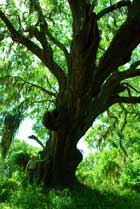
Turns out there are “haves” and “have-nots” even among trees. One of the most surprising finds Murphy turned up was one of those ‘have-nots” standing in a forgotten corner of a neglected old pasture. With a trunk diameter of about nine and a half feet, it’s the largest and probably oldest tree in the project. Until something bigger turns up, that makes it King of the Oaks in Beaufort County. From the look of things, His Majesty’s reign has not been easy. This is no pampered monarch. This is a battle-weary sovereign, pruned by time, exiled at the edge of a fallow field. At first glance it’s just another big tree surrounded by scrub and whittled by weather. Murphy’s right. Trees will fool you. The mind needs time to adjust, to process the mass of the thing, the tale of ages written in its wood. And it is huge. By comparison the more famous oak in front of the Castle is only a bit larger than this behemoth’s most impressive limb.
God is the experience of looking at a tree and saying, "Ah!" - Joseph Campbell
“I think everyone who lives here has the sense that we live in a special part of the country,” says Murphy. “Beaufort’s unique in the fact that so much history, culture and natural beauty is concentrated in this one little area and the trees are integral to that.”
So how do we ensure such beauty for the next three centuries?
"There’s a saying that the best time to plant a tree is twenty years ago,” says Murphy “the second best time is today.”
Get involved with the Beaufort Three Century Project online at www.beaufortthreecentury.org. Mark Shaffer’s email is backyardtourist.com