
| At Play on the Field of Battle |
|
| Written by Mark Shaffer |
| Tuesday, 31 December 2013 17:03 |
|
"War is hell," Ed deadpanned. "And it just might send us there."
In December 2012, re-enactors converged on Frampton Plantation, in what is now called Point South, for a Sesquicentennial reenactment like no other. This would be the first recreation of The Battle of Pocataligo and it would take place on the actual site of the original fight. "This is rare. Very rare," explains Bruce Blackmon. "It isn't often that you get to recreate history on original ground. Most National and State parks prevent that from happening." Blackmon is Colonel of the Palmetto Battalion, a non-profit reenactment organization with 28 years of experience in these matters and one of the organizers of this event.
POCATALIGO, SC December 2012, 150 years and a few weeks later. The air around Frampton Plantation (now home to Long before the first shot is fired, the mundane issues of insurance, sanitation, parking, concessions and such must be sorted out. There's a whole lot more to staging a reenactment than just turning loose a bunch of guys on a battlefield. This is not simply a "reenactment," Blackmon explains. "This is interactive history. There are original [earth] works that run all through the woods that haven't been touched or seen in years," he says. "We went all the way back to the site of the original bridge and one of the nearby landowners gave us a personal tour of his property adjacent to Frampton. There was an original gun emplacement there with a ramp which was used to bring up the Confederate Artillery still in place." Before the pretend fighting begins, personal accounts from the real battle will be read aloud – letters and journal entries from men on both sides of the struggle, some of whom bled their very lives out into these grounds. And then there's the nitty gritty of the actual battle, originally fought through dense forest, brush and swampland. Tomorrow, spectators will line a clearing to witness the spectacle. But before the battle spills out into the open, the troops will skirmish through the woods and around original earthworks engineered by Robert E. Lee on property that belonged to a prominent secessionist.
The Pocataligo Sesqui was initially scheduled for another location before Bristow caught wind of the plan. "And here am I, sitting on the original battlefield!" she notes with a wry smile. The rest just fell into place. "It's the first event of its kind we've had on the plantation," she says, "and the biggest by far."
BIG GUNS "This piece of artillery is a 10 pound Parrott, owned by the Chester Historical Society, dug up in downtown Chester in 1986 after being underground for over 130 years," he explains. There are three more just like it – a whole battery – all buried together in the last days of the war. He shows us how the piece is loaded and fired and tells us about a young boy at another event who blew his arm off ramming the charge in improperly. "He had no business being on that gun," says Terry. Terry, like his compatriots, is awed by the opportunity afforded by Frampton. Coming in the heart of the Sesquicentennial schedule makes it all the more special – a lifetime event. "It gives me cold chills just to think about it," he says. "Any time we can walk onto hallowed ground it's an honor for us 'cause if we go to Gettysburg or Shiloh they won't let us play. The Park Service won't let us. This is one of the very few places we get to play on the real battlefield."
SOUND AND FURY Gradually the sound of the conflict draws near. The crowd of spectators lining the roped off battleground pushes in. Necks crane, digital cameras and smartphones at the ready. A gaggle of young girls chatter loudly between texts, trying to decide if they're headed to Taco Bell or Micky D's after. The horsemen racing out of the trees at breakneck speed shut them up. Major Terry leans on a cane near his Parrott gun. "They're comin'!" Orders are barked. The infantry and artillery make ready. The cavalry slip back into the trees and skirt "Here they come!" The sky is overcast, appropriately grey. Slowly the Bluecoats materialize in the half-light and shadow of the tree line, Blackmon among them. Today he plays the part of a Federal officer. For a moment there is the fleeting impression that they appear as spirits on the edge of a dream firing this dull, strange light. The Parrott's roar shatters the moment and the battle is joined again. One hundred fifty years and a few weeks after the first bloodletting, the only blood spilt here will be from a few scrapes and scratches. And unlike the first engagement, this time the dead will rise to fight another day. I am reminded of Lee's famous quote to Longstreet, "It is well that war is so terrible, else we should grow too fond of it." A few weeks after the smoke clears and the cook fires are cold, I receive a dispatch (email) from Col. Blackmon in response to my inquiry as to his final impressions of the battle. "I have to admit that it was an eerie feeling being on the battlefield at night," he writes. "There is a feeling that goes along with that. I have felt it when I spent the night at Gettysburg and at the Federal prison site at the Florence Stockade. You feel that 'eyes' are watching... and perhaps they are."
POST SCRIPTS Watch Battle of Pocataligo Video: Lowcountry Weekly Publisher, Jeff Evans, was "embedded" with the Confederate troops for exclusive "BattleCam" video. Click on www.lcweekly.com for interviews with the re-enactors and video from the heat of the action and browse more photos in our Facebook gallery.
MORE INFO |
 matter, so does the controversy that still follows this fascination with our bloodiest, most divisive conflict like carrion birds to a battlefield. Sue and Ed, a pair of "hardcore" reenactors Horwtiz' encounters during his ten state adventure in Civil War culture, may be funny – but they aren't really joking. This is religion for some, a lifestyle for others, and an obsession for many. At the very least, as one re-enactor tells me, "it's a damned expensive hobby."
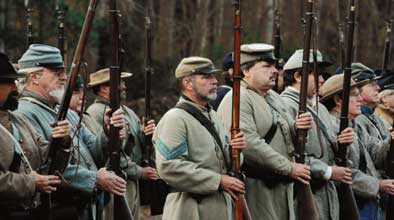
 the Lowcountry Visitors Center & Museum) is thick with the scent of wood smoke and bacon. On the eve of the first reenactment, a small tent city of "sutlers" (merchants and victualers who follow the armies, trading in the field) has sprung up behind the grand old house. Hand painted signs point the way to the Federal and CSA camps sequestered in the woods around the battlefield. Women in hoop skirts glide across the lawn, others in simple Calico dresses poke cook fires and set cast iron to coal. A tall man sporting an elegant top hat and waistcoat strolls the sutler promenade, picking each deliberate step with an ornate cane. Bearded soldiers in blue and grey wander among the campsites catching up with old friends, swapping stories, discussing the finer details of what took place on these grounds a century and a half ago. And what's to come tomorrow. Along with the smoke, a palatable sense of awe hangs in the air.
 "John Edward Frampton was the landowner at the time of the battle and a former senator for South Carolina," says event organizer, Lynn Bristow. "But in 1860 he was one of the original signers of the Ordinance of Secession. So he was a very big player for South Carolina." This sounds even more impressive with her impeccable English accent delivered in full period regalia. The U.K. emigree manages the Visitors Center & Museum at Frampton. Bristow's also a member of the Palmetto Soldier's Relief Society – or "the ladies' side of all this," as she puts it – and sews all of her own exquisite period dresses and gowns.
 Battalion Artillery. The rifled canon his McIntosh Battery will fire in battle is the real McCoy – a still functioning, still lethal relic of The Recent Unpleasantness.
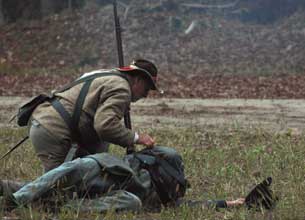
 The shots pop and echo in the deep of the oak and scrub brush as the skirmishers fire and fall back, fire and advance. Back and forth. Back and forth.
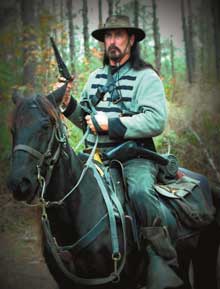
 the clearing, pistols drawn. One fellow aboard a black horse looks as if he's ridden right out of The Outlaw Josey Wales. He sports six pistols – one under each arm, another on each hip and spares in both boots. He calls to mind a line from another Eastwood film, "Unforgiven," "I just don't wanna get shot for the lack of shootin' back."