
| The Myth of Wild Horses |
|
| Written by Mark Shaffer |
| Tuesday, 22 May 2012 13:37 |
|
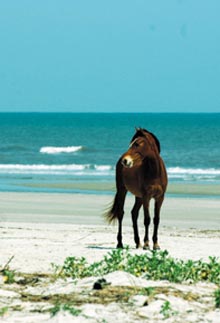
The young bay mare breaks through the dunes and out onto the Her hooves carve deep scars through the fragile sands. Game trails and hoof prints run through, over and around the huge dunes – Cumberland Island’s first and only defense against the fickle whims of the Atlantic Ocean only a few hundred yards away.
It’s mid-March and we’ve come to Cumberland Island with the hope of seeing some of its famous wild horses as part of a project my wife Susan is working on for her PhD. Earlier this morning, as we listen to the Ranger’s briefing prior to boarding the ferry from the St. Mary’s waterfront, a woman anxiously asks, “Will we see horses?” Longtime Park Ranger Rene Noe rolls her eyes in exaggerated bemusement drawing a few chuckles from the group. “Oh yeah,” she says. “You bet you will.” Among the very specific points Noe takes great pains to make during the “dos & don’ts” portion is that approaching the horses is not only dangerous, but prohibited. Shortly after we arrive on the island we watch a woman walk right up to a pair of mares and spend the next fifteen minutes harassing the animals. Fortunately, neither has a foal and there is no stallion in sight. Noe tells us about a young man who proclaimed he was a cowboy and told her that he intended to ride a horse before he left the island. She warned him not to try it. Later in the day a stallion gave the kid a free flying lesson after he surprised the dozing animal from behind. This instantly proves two things: the kid was no cowboy, but he was an idiot. Two hind hooves in the chest got him airborne. The sudden return to earth shattered both arms. His reward, says Ranger Rene, “Was a real bad bumpy boat ride back to the mainland.”
In the early 1880’s Pittsburg steel magnate Thomas Carnegie – brother of Andrew – and his wife Lucy
Cumberland Island is about 18 miles long and features some of the most spectacular beaches to be found on this side of the Atlantic. Developers have long sought a foothold on the island, but Sea Pines mastermind Charles Frazier was the only one to succeed. Flush with the success of his Hilton Head resort, Frazier bought up thousands of acres on Cumberland with plans to build an even more ambitious resort. In the end, he inadvertently fueled an entire conservation movement and a congressional act creating the nation’s first national seashore, preserving much of the island from any possibility of future development (more on that in Part 2). Today the Park Service manages 36 thousand acres of Cumberland with 9 thousand acres designated But perhaps the biggest challenge facing the park, says Boyles, is dealing with “the feral issues” – specifically, horses and hogs. They’re dealt with in decidedly different ways. Free ranging livestock roamed the island for centuries, but as private ownership passed to federal management, that tradition ceased. Horses and cattle have a devastating effect on a coastal environment, grazing down sea oats and marsh grass and trampling the dunes. The cattle have long since been rounded up and removed while the horse population seems to have stabilized at around 150. The pigs are a different matter. The island environment is hog heaven and the population has exploded wreaking havoc on the land and threatening one of the most important nesting areas for loggerhead sea turtles on the Georgia coast. “Sea turtle eggs are like candy to hogs,” says Boyles. “They can destroy an entire nest in a matter of seconds.”
As for the horses, well, it’s complicated. “The Park Service has this awkward relationship with the horses,” says Boyles. “We know they don’t belong here. They’re not native. If you want to find wild horses, go to Algeria. We don’t have wild horses, we have feral horses – livestock that’s been turned out and survived on its own.” For years the Cumberland horses were thought to be direct descendants of Spanish animals abandoned on the island in the late 15th century. A DNA study in the mid 1990’s found the animals to be a mix of common stock, probably turned out by the Carnegies in the 1920’s. In all likelihood Cumberland’s Spanish horses probably wound up in stewpots during the blockade years of the Civil War. Unlike the outlaw pigs however, Boyles says the horses have nothing to fear but an occasional coyote and the limitations of their habitat. And semantics aside – wild or feral – they are a beloved conundrum. Back on the dunes the bay mare finally tires of staring at us. She gives the sandcastle a cursory sniff
TO BE CONTINUED…
COMING UP IN PART 2: Things to do: The Lands and Legacy Tour along “Intersate Zero” Places to stay: Exploring the world class inns of historic St. Mary’s
SPECIAL THANKS & RESOURCES Angela Wigger, Director of Tourism, St. Mary’s CVB (www.stmaryswelcome.com) Emma’s Bed & Breakfast (www.emmasbedandbreakfast.com) Spencer House Inn (www.spencerhouseinn.com) Cumberland Island National Seashore & Park Superintendent Fred Boyles (www.nps.gov/cuis)
Email Mark Shaffer at This e-mail address is being protected from spambots. You need JavaScript enabled to view it
THE BASIC INFORMATION The National Park Service limits the number of visitors to Cumberland at 300 per day. That breaks down to about 120 campers and 180 day-trippers. Since campers are allowed to stay on the island for up to seven days (and many do just that), campsites and day passes can be hard to come by. Everyone gets on and off the island by a ferry that makes two runs from St. Mary’s to the island and back each day. Ferry reservations may be made six months in advance. Once on the island pay attention to the departure times. Miss the last boat off the island and you’ve got two choices, tough it out on your own overnight or cough up big bucks for a charter back to the mainland.
There are no supplies on the island, although drinking water is available at some locations on the south end. The rule here is simple: pack it in and pack it out. Fires are permitted only at the “civilized” campground at Sea Camp Beach, which also has bathrooms and cold showers. No campfires are allowed in the three backcountry camping sites nor are there any civilized comforts. Camp stoves are recommended and the well water must be treated to be potable.
Fishing is permitted (Georgia State laws apply); interacting with the local wildlife is not. While the semantic debate continues over Cumberland’s famous horses, the fact remains that whichever term applies – feral or wild – they are anything but tame and have sent many a visitor to the hospital. Under no circumstances should they be approached. The island is also home to several species of poisonous snakes – diamondback rattlers are the most common – as well as alligators, coyotes and a large and troublesome population of feral pigs. A number of managed hunts are held by lottery each year to help control hog and deer populations.
For more information, ferry reservations and camping permits call 877-860-6787. |
 The Backyard Tourist explores St. Mary’s and Cumberland Island National Seashore
 vast sugary beach at a canter, tossing her head and flaring her nostrils as she spots us. Someone’s built a pretty impressive sandcastle near the tide line. She slows to a leisurely walk, examining this curiosity before stopping to stare at us. Her dappled grey companion ignores us completely and continues to graze off into the fore dunes, munching on the sparse vegetation that literally holds the beach together. She is an equine conundrum and the center of fierce debate and a decades long controversy.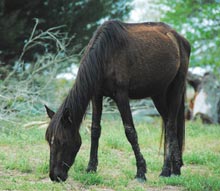
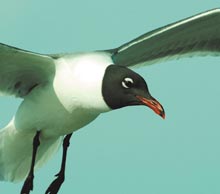
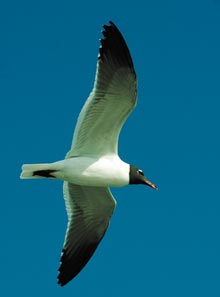
 The “Wild Horses of Cumberland Island” have long been one of the marquis draws to Georgia’s largest barrier island, along with miles of pristine beaches, marshlands and maritime forests. Cumberland is home to 335 species of birds and is a crucial nesting ground for sea turtles. The island also bears the ruins and remnants of a diverse history filled with early Native Americans, European explorers, pirates, wars, plantation owners and slaves as well as their common descendants. But it was the arrival of the Carnegie family in the closing years of the 19th century that would eventually set the pieces in play to create the nation’s first National Seashore.
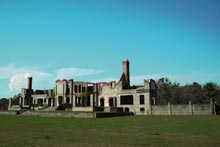 began buying up the island as a southern retreat. They would eventually own 90 percent of Cumberland, which is a third larger than the island of Manhattan. The Carnegies built Dungeness, their massive Queen Anne style mansion, on the southern tip of the island. Thomas Carnegie died before the house was completed in 1886, but Lucy remained at Dungeness until 1929, building estates around the island for some of the couple’s nine children. Two of those homes survive. Greyfield remains a family property and the island’s only privately run (and very exclusive) inn. Plum Orchard, in the center of the island is owned and maintained by the Park Service. Dungeness stands in ruins, destroyed by arson in 1959, some say as the result of a nasty confrontation between Carnegie gamekeepers and poachers. Family members staying at Plum Orchard watched the flames on the south end leap into the night sky miles away.
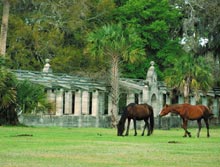
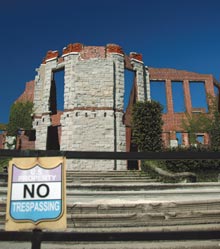 In its heyday Dungeness was completely self sufficient, supplying the rest of the island’s estates with everything from meat and milk to seafood, fruits and vegetables. The Carnegies even grew their own mushrooms. Today what remains of the house is a haven for rattlesnakes, while the expansive lawn and grounds are pastures for the island’s famous and controversial horses. Piles of dung dot the landscape creating the illusion that the estate was hit with a mortar barrage. Most of the outbuildings have been allowed to crumble away. The last automobiles to occupy the estate’s garage sit out in the open, literally rusting into the earth.
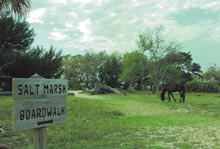 For our first day on the island we’ve chosen to hike a loop around the southern end beginning and ending at the Icehouse docks on the Cumberland Sound. For day two Susan’s booked us on the park’s newest attraction. The Park Service launched the Lands and Legacy Tour in August 2011. The daylong guided van tour is limited to just 20 individuals in two vehicles and includes stops at Plum Orchard and First African Baptist Church, the tiny chapel famous for hosting John F. Kennedy, Jr’s wedding to Carolyn Bessette.
 as National Wilderness. And according to Park Superintendent Frank Boyles, the park remains at the center of a constant flow of controversy and litigation. The latter comes by way of islanders who agreed to retaining rights when the government began acquiring the land in the late 1960’s. Most of those rights – usually a 40-year agreement – are beginning to expire, and Boyles says the lawsuits are piling up. Another major issue is managing access to the island. Cumberland is the most restricted property in the National Park system. A single ferry with a capacity to carry 146 passengers is the park’s only public access. In turn this limits the possibilities for economic development in St. Mary’s and surrounding areas.
 The park organizes several managed hunts each year to help control the population. Meanwhile the park biologist personally culls hundreds annually, specially licensed and equipped with a silenced high-powered rifle and night vision scope.
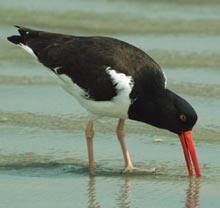 and joins her companion to graze on the sea oats. American Oystercatchers wade the shoreline, probing the sands for small shellfish. To the north the beach curves on into the horizon the color of sun-bleached ivory without evidence of human kind in sight. The only sounds are the wind, the surf and the cry of seabirds.