
| Live Oak Legacy: Part One |
|
| Wednesday, 28 April 2010 14:12 |
|
The Backyard Tourist has it made in the shade... 
Editor’s note: The Beaufort Three-Century Project will present Beaufort’s Live Oak Tree Legacy and Community Forestry: Past, Present & Future—A Symposium from 8:30 a.m. to 3:00 p.m. on Thursday, April 29, 2010 in the MacLean Hall auditorium (Building 12) at the Technical College of the Lowcountry located at 921 Ribaut Road in Beaufort. Three optional tree tours will be offered following the program, including a guided tour of trees located on private property not usually accessible to the public. The registration deadline for the event has passed, however, last minute inquiries may be made by calling Deborah Johnson at 843-489-1711.
A tall taleThe tree, which moves some to tears of joy, is in the eyes of others only a green thing that stands in the way. Some see Nature all ridicule and deformity and some scarce see Nature at all. But to the eyes of the man of imagination, Nature is Imagination itself - William Blake, 1799, The Letters One wonders what Blake might have made of a canopy of giant live oaks all dripping in Spanish moss, dancing in the breeze like widows’ dreams. I like to imagine that as Blake penned those thoughts more than two centuries ago some of the trees that awe us today were already amazing the locals. Rediscovering and documenting this living history has been a passion project for arborist Michael Murphy these last twelve months. He brought the idea of a comprehensive tree study to B3C Project Coordinator Deborah Johnson. “She had a call out for projects to help Beaufort transition into it’s fourth century,” says Murphy. “And the age of our trees has always been kind of a grey area and one that people are interested in.” Apart from running his business, Preservation Tree Care, Murphy’s spent the better part of a year wrapping his measuring tape around the trunks of some of the oldest and largest trees in the state. He’ll present his findings during the landmark B3C symposium. The event brings together a stellar list of experts, each presenting in a distinctive area of expertise including internationally known biogeographer and climatologist Henri Grissino-Mayer from the University of Tennessee. Dr. Grissino-Mayer’s expertise in deciphering tree ring data (dendrochronology) has been featured in documentaries shown on the History Channel, the Weather Channel, National Geographic Channel and others. An episode of Discovery’s Extreme Forensics followed Grissino-Mayer and his students as they used forensic techniques to analyze wood fragments collected as evidence in a murder case. Their findings resulted in a very CSI-like arrest and conviction.
It is not so much for its beauty that the forest makes a claim upon men's hearts, as for that subtle something, that quality of air that emanates from old trees, that so wonderfully changes and renews a weary spirit. - Robert Louis Stevenson
Made in the shade
The short answer is “plenty.” Our history is undeniably tangled in the very roots and branches of the oaks that surround us. Indeed, the tree itself is indelibly attached to a pair of the most important events in Beaufort County. The seeds of the Civil War took root beneath the Secession Oak in old Bluffton, while St. Helena’s Emancipation Oak is where slaves first heard and still celebrate Lincoln’s proclamation of freedom. Perhaps no other place can claim two such deeply opposite historic associations with a tree. But the value of these trees – and the value of all of our trees – runs far beyond history and aesthetics. “There are all kinds of values we don’t think about,” says Johnson. “They reduce energy costs in your home and make your property more valuable. Trees cool the city and change the environmental footprint in the big global scheme of things. There are all kinds of advantages to trees. Beaufort is a Tree City and you have to work to be a part of Tree City USA®.” The Arbor Day Foundation sponsors Tree City USA® in cooperation with the USDA Forest Service and the National Association of State Foresters. The program aims at providing support and recognition for urban and community forestry programs. Beaufort’s been a member for twenty years. Hilton Head joined the club eight years ago. Even so, the fate of our treasured urban treescape isn’t always within our control.
God has cared for these trees, saved them from drought, disease…and a thousand tempests and floods. But he cannot save them from fools. - John Muir
Big surprises and bragging rightsOnce the word was out that a survey of the area’s trees was in the works, Michael soon learned that in the Lowcountry big trees are like opinions: everyone’s got one and they’re all important. “We asked the public to call in tree locations,” explains Murphy. “The response was enormous. It was overwhelming. There were a few duplications, but there were also some hidden away in forgotten corners. We’d often go to visit a tree that had been called in and there was another one right over there.” He didn’t have to travel far for some of the most remarkable finds. “Some of the best discoveries are right here in Beaufort,” says Murphy. “One is a farm site documented from the early 1700’s. It has four of the largest trees that we’ve measured, and that’s what we wanted to do – find trees that some of our earliest settlers might have walked under.” A short drive later – and with the owner’s permission – we’re standing where some of those settlers once stood. The old house sits on a bluff of the Broad River shaded by one of the four giants. “How old is that tree?” The owner prods Michael with a good-natured grin. This is the first of two sites we’ll visit. Both are on private property and the locations remain undisclosed at the request of the owners. Big trees, like rock stars and NBA players, have groupies who often disregard property lines and decorum in the pursuit of their passion. “Oh, probably around three hundred,” Michael replies after a moment’s consideration. “That all? I would of thought around a thousand!” He wonders off amused at his jibe. He’s brought up a good point, though and a frustrating one to some extent. Correctly aging living trees is tricky business. The only accurate way to get the exact age of a tree is to count its rings. There are two ways to accomplish this: take a cross section of the trunk (which means cutting the tree down) or bore through it for a core sample. Easy enough if you’re dealing with a dead or dying tree. Neither are options for this study. Instead, Murphy’s using an aging model formulated by Dr. Grissino-Mayer based on tree samples from Charleston and Beaufort, the latter delivered in person by Deborah Johnson (more on that in Part Two). In essence, he’s examined some really big chunks of old dead trees to document growth patterns, trends and variables on which to base very well educated estimates on the age of living trees. Like everything else, a well-tended tree grows faster and more lush than one left in the corner of a pasture to the whims of Mother Nature. Downtown Beaufort is a case in point. Photographs from the Civil War era show a city in dire need of some shade. Most of the big trees we tend to take for-granted as having always been here are veritable sprouts in terms of live oak time. “Trees can fool you,” says Murphy. The spread of limbs isn’t always equivalent to the size of the trunk. The famous Angel Oak near Charleston was once thought to be one of the oldest living organism east of the Mississippi at around fifteen hundred years. Its trunk is a tad over eight feet in diameter while the remarkable sprawl of limbs covers seventeen thousand square feet. But according to Murphy, new research indicates the Angel Oak is probably much, much younger. “It’s because it’s such an impressive presentation of a tree,” says Murphy. “It’s had the opportunity to grow and expand while others have not.”
God is the experience of looking at a tree and saying, "Ah!" - Joseph Campbell “I think everyone who lives here has the sense that we live in a special part of the country,” says Murphy. “Beaufort’s unique in the fact that so much history, culture and natural beauty is concentrated in this one little area and the trees are integral to that.” So how do we ensure such beauty for the next three centuries? "There’s a saying that the best time to plant a tree is twenty years ago,” says Murphy “the second best time is today.” Get involved with the Beaufort Three Century Project online at www.beaufortthreecentury.org. Mark Shaffer’s email is backyardtourist.com
|


 Grissino-Mayer breaks down the science of dendrochronology as well as the value of old, historic trees in the United States. Joining him on the program are: Kelby Fite, an arboricultural researcher for Bartlett Tree Research Laboratories speaking on large tree preservation; Liz Gilland of the South Carolina Forestry Commission, discussing community forestry; and Laura Lee Rose of Clemson Extension, presenting on local tree planting. Like one of those big oaks, this all sprang from the nut of Murphy’s simple idea. “Originally the main focus of this whole project wasn’t to have a symposium,” he says, “it was to see if we could find a tree that may have had early settlers beneath it three hundred years ago.”
 When I was a boy I was certain the great oaks that canopied the various streets of my hometown were of a species known as “shade.” That’s the name I heard most growing up, “shade tree.” Southerners who can recall the novelty of “conditioned air” know this term. Even within our hermetically sealed, climate controlled homes, true Southerners still value a good shade tree, and, in these parts, live oaks make the best. They spoil us with prime shade – a damn fine commodity with which to be spoiled once summer’s screen door to hell opens. Long stretches of roadways rarely glimpse the sun once spring arrives, veiled in gnarled canopies of oak. Visitors to the old historic neighborhood of The Point in Beaufort marvel at the expanse of the live oak that lords over The Castle – barely an above average specimen, according to Murphy. In fact, there are few things as synonymous with the Lowcountry as these moss-draped giants. Some of them are even kind enough to bend a limb low for a weary traveler to perch on and take shelter from a sultry summer’s day. Like Blake, it is difficult to stand dwarfed in the shadow of such a thing and not try to imagine who and what might have taken refuge beneath it over the centuries – what dramas unfolded within its span of life, leaf and limb?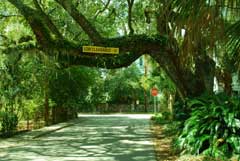
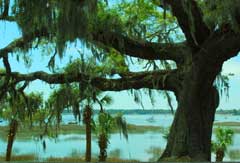 The morning I set out to meet Michael Murphy (and do a little tree documentation of my own) I drive down North Street in Beaufort, near the elementary school. For several days now the town’s been overrun with tree service trucks. Men in hardhats ride cherry pickers into the trees to clear branches from the power lines. Half a dozen crews in the employ of SCE&G have been hacking away at the canopy above the few blocks of North from the school to Ribaut Road. I find the timing ironic with Earth Day approaching. A well-dressed older couple assess the damage to the tree tops at the edge of their property. They hold hands, gazing up in disbelief at what can only be described as mutilation. They both look on the verge of tears. Across the street a neighbor has erected a hand drawn sign: Fresh Devastation Wrought By SCE&G. It would appear the power lines are safe for a very long time.
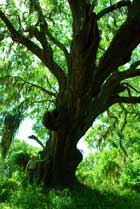 Turns out there are “haves” and “have-nots” even among trees. One of the most surprising finds Murphy turned up was one of those ‘have-nots” standing in a forgotten corner of a neglected old pasture. With a trunk diameter of about nine and a half feet, it’s the largest and probably oldest tree in the project. Until something bigger turns up, that makes it King of the Oaks in Beaufort County. From the look of things, His Majesty’s reign has not been easy. This is no pampered monarch. This is a battle-weary sovereign, pruned by time, exiled at the edge of a fallow field. At first glance it’s just another big tree surrounded by scrub and whittled by weather. Murphy’s right. Trees will fool you. The mind needs time to adjust, to process the mass of the thing, the tale of ages written in its wood. And it is huge. By comparison the more famous oak in front of the Castle is only a bit larger than this behemoth’s most impressive limb.