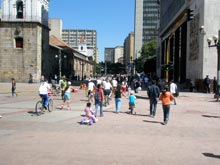
One aspect of good city design and planning is retrofitting – figuring out how to take what already exists and transform it into something better. Buildings are often retrofitted for different uses, but we needn’t stop at the building level. The redesign of existing streets, alleys and paved spaces – better utilizing the excess pavement space that so many of our cities and towns have – is an important aspect of urban retrofitting as well.
In some cases, that simply means we should reduce or remove travel lanes in favor of more on-street parking, wider sidewalks or better provisions for street trees. These are all simple things that can greatly increase our quality of life, and minimize the destruction that planning for high-speed, high-capacity traffic has done.
In other cases, it means getting creative, and using our spaces more efficiently for more hours of the day. When we talk of the 3-legged stool of community building that is design-policy-management, this is often the “management” portion that too often gets neglected.
How about some examples?
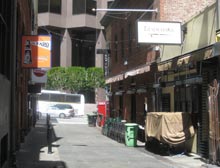
Belden Alley in San Francisco is a great model. By day, this is a typical service alley like so many in any downtown or urban area. By night, however, the alley transforms. Restaurants actually open onto the alley, and move tables and chairs out onto the pavement space. Bollards are placed at the alley entries so that vehicles cannot drive through. The space becomes alive with people relaxing and enjoying the evening.
The same condition exists in various ways in older cities throughout the United Sates. This approach incidentally helps with safety as well by providing more activity in otherwise dark areas.
Historic Bluffton has the Carson Cottages off of the main street. This cottage court, a new infill project, was designed to feel like a hidden Chareston alley that had been transformed into a livable space. It is the welcoming home to restaurants and shops, and plays host to the weekly farmers market.
We need not stop at just alleys. Our streets themselves deserve the same kind of thinking. Again, by thinking creatively about how to manage space, we can create more life, and more pleasure in our cities. A great example is the Cicolvia phenomenon. Begun in Bogota, Colombia, the idea was borne to shut down a large amount of the city’s streets (or portions of streets) for most of the day on every Sunday. On the temporarily-closed streets, people ride bikes, jog, walk with their kids, play games and much more. This is one of those experiments that the people who live there truly enjoy. Just think of our own over-sized streets, and how easy it would be to close them down for a “slower” Sunday to get out and simply enjoy life in the neighborhood or the City.
Downtown Beaufort has a few opportunities for this as well. During the March design charrette lead by the city, it was proposed that Port Republic act this way – utilizing a special type of pavement surface, it could function as a street on a normal basis, but then be closed off for festivals and other activities. Bay Street also transforms into a pedestrian street a few times a year, such as the Halloween Parade and A Night on the Town around Christmas-time.
The possibilities are endless – the only hurdle we have to overcome is the assumption that all pavement space must be for vehicles all the time. Ray Bradbury eloquently wrote about this in the short story, The Girls Walk This Way:
“We drive… and drive… and drive and come home blind with exhaustion. We have seen nothing, nor have we been seen. Our total experience? Six waved hands, a thousand blurred faces, seventeen Volkswagon rears and some ripe curses from a Porsche and an MG behind.” And later: “Now we must remember that drama and theater are not special and separate and private things in our lives. They are the true stuffs of living, the heart and soul of any true city. It follows we must begin to provide architectural stages upon which our vast populations can act out their lives.”
This article was written for Lowcountry Weekly by the Congress for the New Urbanism – Carolinas Chapter. For more information visit www.cnu.org
Are our settlement patterns a matter of National Security?
Tuesday, 24 May 2011 15:29
Here in the Lowcountry, one has only to look as far as Savannah and Charleston to see examples of places planned around safety and security. Remnants of the original city wall that protected Charleston still are visible beneath the old Exchange Building. And Savannah’s beloved squares that pattern the city were based upon the design of military camps and used for regular military exercises and drills, all in preparation to defend the small, compact settlement on the water. Beyond these camps and walls lay the agricultural lands that fed the cities, ample area to produce everything the citizens needed, literally right outside their limits of development.
Last month, Beaufort’s newly formed, Office of Civic Investment presented the results of their week long charrette for downtown Beaufort. Represented were an exceptional range of ideas for infill, redevelopment and extension of the downtown core. The team offered proposals for where we build, what we build and how we build. Including both private and public sectors, they set forth alternatives to calm thoroughfares, celebrate the pedestrian, enhance existing and add new civic spaces, re-activate and grow commerce, and provide a broader range of dwelling options.
Res Privata or the Private Realm is the main fabric of our communities and daily lives. It, along with Res Publica - the Public Realm - form the Complete City or Civitas. (The Public Realm and the Complete City have been described in previous articles.)
These two Realms, public and private, describe the physical built form and fabric or the “hardware” of a city. One without the other is not complete and each realm will contribute to the true nature of a community or place.
On Thursday, April 21, the CNU Carolinas Chapter is hosting Mary Newsom from Charlotte, NC, at 6:30 pm in the TCL auditorium. She’ll be speaking to Beaufort about the realities of living in, growing and sustaining a vibrant place. Newsom is an associate editor and op-ed columnist for The Charlotte Observer and has been covering growth, neighborhoods, urban design, sustainable development and related topics since 1995.


 Culture - Civitas


 One aspect of good city design and planning is retrofitting – figuring out how to take what already exists and transform it into something better. Buildings are often retrofitted for different uses, but we needn’t stop at the building level. The redesign of existing streets, alleys and paved spaces – better utilizing the excess pavement space that so many of our cities and towns have – is an important aspect of urban retrofitting as well.
 Belden Alley in San Francisco is a great model. By day, this is a typical service alley like so many in any downtown or urban area. By night, however, the alley transforms. Restaurants actually open onto the alley, and move tables and chairs out onto the pavement space. Bollards are placed at the alley entries so that vehicles cannot drive through. The space becomes alive with people relaxing and enjoying the evening.
 Here in the Lowcountry, one has only to look as far as Savannah and Charleston to see examples of places planned around safety and security. Remnants of the original city wall that protected Charleston still are visible beneath the old Exchange Building. And Savannah’s beloved squares that pattern the city were based upon the design of military camps and used for regular military exercises and drills, all in preparation to defend the small, compact settlement on the water. Beyond these camps and walls lay the agricultural lands that fed the cities, ample area to produce everything the citizens needed, literally right outside their limits of development.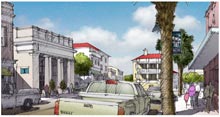
 Res Privata or the Private Realm is the main fabric of our communities and daily lives. It, along with Res Publica - the Public Realm - form the Complete City or Civitas. (The Public Realm and the Complete City have been described in previous articles.)
 On Thursday, April 21, the CNU Carolinas Chapter is hosting Mary Newsom from Charlotte, NC, at 6:30 pm in the TCL auditorium. She’ll be speaking to Beaufort about the realities of living in, growing and sustaining a vibrant place. Newsom is an associate editor and op-ed columnist for The Charlotte Observer and has been covering growth, neighborhoods, urban design, sustainable development and related topics since 1995.